The extraordinary growth of the private credit markets, and significant increase in direct
lending funds as preferred financing vehicles, are increasingly transforming the
marketplace for multi-billion transactions that are reshaping industries.
By some estimates, global private credit assets under management surpassed $3 trillion
in 2024. And asset managers that once would have used public financing and
syndications are now relying on direct lending funds to complete deals more quickly
and with less regulation.
To support this rapid growth, trusted service providers are helping asset managers
improve a wide range of functions, including reengineering operating models,
developing new technology and data systems, and implementing multi-jurisdiction
reporting solutions.
The opportunities and challenges facing private markets and direct lending are explored
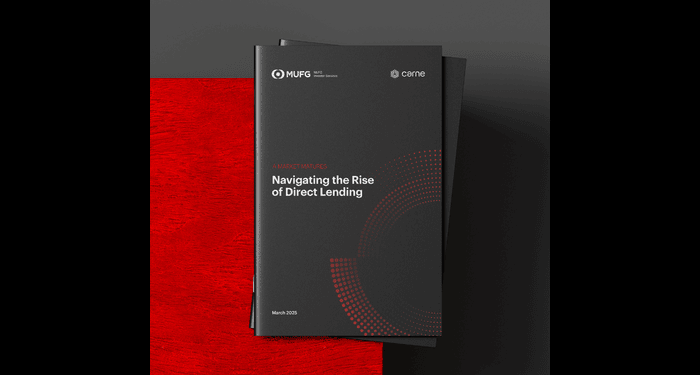
in a recent white paper by MUFG Investor Services and Carne Group, “A Market
Matures: Navigating the Rise of Direct Lending.” The paper, developed with Treabhor
Mac Eochaidh, Global Head of Private Debt, MUFG Investor Services, and Des Fullam,
Chief Regulatory & Client Solutions Officer, Carne Group, outlines how asset managers
are adapting to the changing market, while outsourcing functions to address volumes of
new capital and meet investor expectations.
The Growth of Direct Lending and Private Markets
The paper explains how direct lending took hold in the aftermath of the Global Financial
Crisis, as new regulations forced banks to hold more capital and reduce risk exposure.
Direct lenders moved in quickly, focusing initially on middle-market companies too small
to enter public markets, as well as on high-risk companies or those with specialized
needs.
Since then—through periods of fluctuating interest rates, the COVID-19 pandemic, and
global economic uncertainty—institutional and now retail investors have been attracted
to the strong returns in private markets. In fact, during the past decade, investors saw
direct lending as a tool for increasing returns, generally from 5% to 9%, based on the
spread from floating-rate, closed-ended loans, according to Preqin data.
The growth in private markets continues. Private debt assets doubled between 2019
and 2023, and are forecast to grow at a compound annual growth rate of 9.88% from
2023 to 2029, Preqin said.
New Investors, New Needs
In addition to traditional institutional investors, retail investors attracted to strong
performance and returns in private credit could bring as much as $1.3 trillion into the
global private markets, and asset managers have about $3.9 trillion in uninvested
capital or “dry powder” available to invest, according to the white paper.
Asset managers are already developing new funds and finding opportunities to enable
investors to access private market assets. For example, in Europe and the United
Kingdom, wealth managers surveyed for Carne’s Atlas 2024 report indicated they plan
to increase investments in the European Long-Term Investment Fund (ELTIF)
framework and United Kingdom Long-Term Asset Funds (LTAFs). In the report, 88% of
managers surveyed anticipated increasing investments in private markets in the United
Kingdom and Europe in the next three years because of LTAF/ELTIF
opportunities—with 28% of the respondents expecting a dramatic increase.
Assets managers are competing to attract the new retail capital but recognize that there
are challenges. Retail investors are used to more transparency and faster reporting than
typically provided in private markets and expect some liquidity with their investments.
To meet that demand, fund managers are turning to “evergreen and semi-liquid
structures that blend commitments of traditional closed-end funds with providing at least
partial liquidity that retail investors are used to having,” the paper said.
Enter Trusted Partners
Asset managers and trusted outsourcing partners are working closely to manage the
flow of new investors and capital. The work includes reengineering operating models to
improve efficiency, reduce costs, drive growth, and introduce new products. At the same
time, managers are exploring whether to pay the costs of upgrading back-, middle-, and
front-office functions internally, or leverage new platforms, processes, and systems
already developed by trusted partners.
In addition, partners will provide trained teams, platforms and processes for work
ranging from modeling, reviewing, and verifying credit agreements and loan documents
to administering and servicing loans across the life cycle, and monitoring interest
payments to manage volumes of new data and produce validated reports.
According to Carne’s Supermodel report, asset managers surveyed plan to increase
outsourcing, as “51% of managers (surveyed) with proprietary management companies
said they would outsource more functions over the next two years.” In addition, 29% of
the firms surveyed indicated they might fully outsource management company
responsibilities to support new products.
What the Future Holds
The growth of direct lending as a “go-to” source of financing also has drawn attention
from regulators, who want to ensure retail investors are educated about potential risk,
as well as banks, who argue that there is an unfair playing field because they are
restricted by significant capital requirements, the white paper said.
Direct lenders argue that investors benefit in large and smaller transactions because
companies borrow money more efficiently, shareholders should see higher profits, and
that systemic risk is reduced by using closed-ended funds with significantly lower
leverage than banks.
As private credit continues to grow, direct lenders will aggressively pursue new
opportunities to finance projects including government infrastructure, climate, and
energy initiatives around the world.
Read the full report here:
Navigating the Rise of Direct Lending | MUFG Investor Services