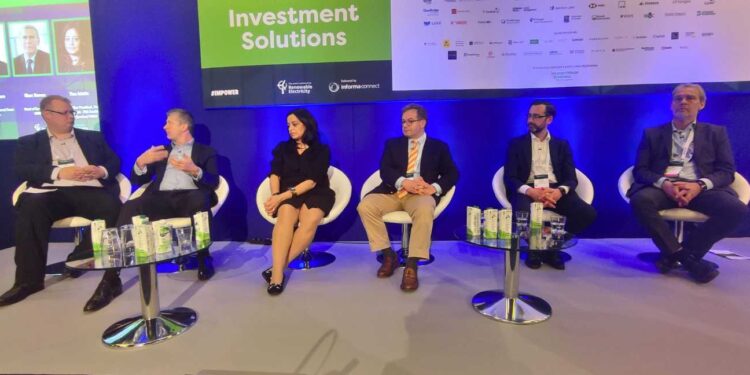
A FundForum panel in Monaco examined fixed income opportunities and strategies, emphasising the importance of resilience in a potential recession.
The panel discussion, titled ‘The fixed income revival..?’ involved experts from law firms and investment and asset managers and was moderated by Paul Whelan, partner, co-head of global fixed income investment manager research at Aon Wealth Solutions, also investigated new approaches adopted by retail and institutional players.
Jeremy Cunningham, investment director for fixed income at Capital Group, highlighted investment-grade corporate bonds and emerging market debt, particularly in local currencies, as areas of opportunity. He mentioned that high-yield corporate bonds in today’s higher-quality market yield around 8-9%, implying an annualised return of that level over the next five years.
Thomas Moore, co-head fixed interest team at Invesco, commented on the cash versus fixed income debate, noting that a long time horizon is necessary when transitioning from cash to credit due to the potential for substantial returns from extending duration.
Marc Rovers, head of euro credit at Legal & General Investment Management (LGIM), discussed the increasing divergence between different types of bonds and emphasised the need for discipline in approaching the market.
Rovers also acknowledged that while there have been opportunities for significant returns in corporate bonds over the past nine months, there were also periods where significant losses could occur.
Tina Adatia, executive vice president, fixed income strategist at PIMCO, argued that fixed income appears more attractive than equities as it provides yield and duration benefits even in the face of a recession. She emphasised the need to create a portfolio resilient to a recessionary environment due to increased financing costs.
Doug Farquhar, lead portfolio manager green, social & impact bonds at Goldman Sachs Asset Management, highlighted the unique features of sustainable bonds, such as green and social bonds, which provide access to issues addressing environmental and social challenges.
Farquhar also emphasised the aim of maximising opportunities pre and post-issuance, with a focus on achieving “net zero.” Farquhar noted the growth of the green bond market and the potential for certain sectors, particularly industrials, to make greater use of sustainable bonds to accelerate the transition and mitigate climate change risks.
Farquhar also discussed the challenges in the social bond market and the need for issuers to define the target population and link bond issuances to their core business and ESG risks. He highlighted the importance of supporting issuers with data generation and standardised definitions for the long-term growth of the market.
The panel concluded that bottom-up approaches, credit selection and name selection would be vital for fixed income investors during a recession. They advised investors to think in terms of a long-term time horizon to ride out volatility and collect on the available yields in the market without taking significant risks that go against their own interests.
© 2023 funds europe