If the digital assets market is going to be successful with investors, there needs to be an ‘ecosystem’ rather than a collection of separately developed platforms and ‘solutions’.
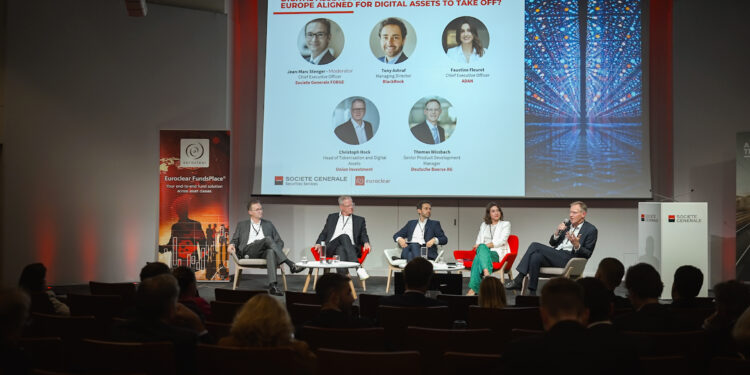
This was the central point made by a panel of digital assets managers and service providers at the European Investor Summit, held by Societe Generale Securities Services at its Paris office on October 1.
The digital assets market continues to develop at pace – the AuM in tokenised funds has exceeded $500 million, stablecoins are recording daily highs, digital bond issuance is increasing in frequency and size and central banks are busy developing central bank digital currencies.
In fact, the European Central Bank is one of the most active on this front with a digital euro expected to be in circulation by 2026.
Meanwhile, the benefits of digital assets and tokenisation specifically are becoming clearer to market participants.
“Tokenisation is a great starting point for traditional asset managers because it is much more familiar to them than crypto,” said Faustine Fleuret, chief executive officer for European association of crypto markets ADAN.
“It will help to open up new experimentation with new digital assets and more specialised startups.
We’re really early in the journey but it is important that people start to get involved.”
Traditional asset managers are also expanding their work on digital assets and tokenisation.
Some of the biggest names in asset management have been working on their digitalisation strategy for eight years or more.
The attraction for asset managers is that tokenisation makes it easier to transfer ownership or to use it as collateral.
The evolution of digital assets has been compared to the emergence of hedge funds and then ETFs. And similarly, the panellists agreed that solutions cannot be developed in isolation. Instead, there has to be an ecosystem.
Tokenisation benefits
One of the characteristics of tokenisation is the ability to create fractionalised shares, said Christoph Hock, head of tokenisation and digital assets, Union Investment.
“Blockchain can help us improve our processes, be that settlement or issuance, settlement in an atomic way”
Christoph Hock, head of tokenisation and digital assets, Union Investment
“You can use it as a wrapper and offer small increments to retail investors especially so they can set up monthly savings plans. These increments can be allocated to traditional asset classes but also typically non-investable asset classes.”
The panel also cited the potential benefits of the underlying blockchain technology as a means to improve multiple processes, especially in the back-office.
“Blockchain can help us improve our processes, be that settlement or issuance, settlement in an atomic way,” said Hock.
“Processes will be much quicker, it can remove certain risks, create new roads, new competition and will drive cost down.”
The “really juicy part”, said Hock, is the ability of blockchain technology to enable the development of new products and operating models in addition to improving existing processes.
For example, with the right end development as well as market developments like T+0 and 24/7 trading, investing will become as digital as other lifestyle processes.
It is also about the workflow, said Thomas Wissbach, senior product development manager, Deutsche Boerse. “If you think about how we consume music these days and what that means for securities, it is a digitisation issue. Digital assets may be in its infancy but we know the technology is good, so people should get involved.”
However, collaboration rather than disruption will be key to the success of digital asset management, agreed the panel.
“The traditional market has tools that already work so competition is key, otherwise there is no incentive to change,” said Fleuret.
“You also need the collaboration and a symbiosis between TradFi and DeFi. The former has the infrastructure and the compliance processes etc. We need everyone sat at the table combining our expertise,” said Fleuret.
It is also important to consider the potential for disruption from digital assets and the implications for market participants, said Hock. As he reminded the audience, Nokia was once the biggest mobile phone operator in the world and people once laughed at Apple and its ‘smartphone’ concept.
“We see the same development in the automotive industry where traditional players will run into trouble if they don’t have an electric vehicle,” said Hock.
It remains to be seen if digital asset management will become as ubiquitous as electric vehicles but, as the panel concluded, asset managers must at least be cognisant of these developments and get involved.
As one of the panellists said: “It is a journey but firms should start on it now.”