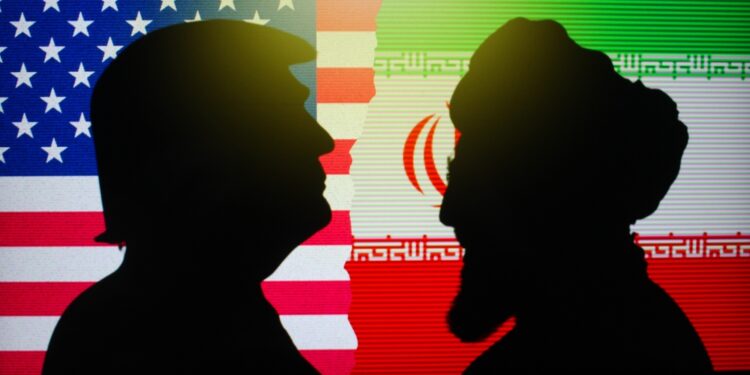
Escalating tensions between the US and Iran have jolted energy markets and revived inflation concerns, but investors remain divided over whether the flare-up will prove short-lived or evolve into something more destabilising.
Brent crude briefly pushed above $82 a barrel in Asian trading before easing back toward $78, still around 7% higher on the session (Reuters). The move has sharpened focus on oil as the key transmission channel from geopolitics to global markets.
Hakan Kaya, senior commodities portfolio manager at Neuberger Berman, said the scale of what is at stake “cannot be overstated”. Iran produces roughly 3.4 million barrels per day of crude and condensate and exports about 1.7 million barrels per day, largely to China. More critically, around 20 million barrels per day of oil — and nearly a fifth of global liquefied natural gas supply — transits through the Strait of Hormuz.
“If the Strait remains impaired for any meaningful duration, the price consequences become nonlinear,” Kaya said. A disruption lasting days could be absorbed through storage drawdowns, but a closure measured in weeks would deplete buffers and could push crude well into triple digits.
Nigel Green, chief executive of deVere Group, warned the surge risks reigniting inflation just as central banks believed price pressures were coming under control. “Investors are now confronting a renewed inflation threat at a moment when price growth in major economies remains above or only just approaching central bank targets,” he said. “When Brent jumps at this speed, inflation arithmetic changes quickly across developed economies.”
The Bank of England estimates that a 10% rise in Brent typically adds 0.2 to 0.3 percentage points to UK inflation. Green argues that the multiplier effect is being underestimated. “A sustained move of this magnitude would materially lift headline CPI in the UK,” Green said.
He extended the warning to the US, noting that fuel costs feed directly into consumer sentiment and expectations. If crude were to climb toward $90 or $100 a barrel, the pass-through into CPI would become “unavoidable”. Even if core measures exclude food and fuel, higher oil prices bleed into freight, manufacturing and distribution costs.
For Europe and Australia, still grappling with above-target inflation, sustained energy pressure could complicate plans for monetary easing.
Lindsay James, investment strategist at Quilter, also highlighted the Strait of Hormuz as the central risk but cautioned against assuming a prolonged shock.
“Events in Iran in recent days have brought the vague concept of ‘higher geopolitical risk’ from the back pages of presentations to the forefront of investors’ minds,” she said.
Gas markets are already reacting. European gas prices have risen more than 20% as stockpiles remain tight. UK households are temporarily shielded by the April energy price cap, James noted, but businesses could feel the impact faster.
Defence tech emerges as strategic allocation
James was sceptical about traditional defensive plays. Gold, now trading at $5,278 an ounce after surging over two years, may no longer offer the same asymmetric protection. Similarly, government bonds are not the obvious haven if the core risk is another inflation spike.
Still, James believes markets may regain composure. There is no formal closure of Hormuz, and any sustained disruption would likely provoke a coordinated international response.
“Ultimately therefore calm should prevail in markets before too long, even if a period of volatility may now be in store,” she said.
That view broadly aligns with Lombard Odier’s CIO Office, which said its base case remains a negotiated outcome. The bank argues that while oil markets create a direct link between geopolitics and the global economy, crude prices remain below the peaks seen in 2022.
Lombard Odier outlined two risk scenarios: limited US strikes without lasting disruption, and a more severe escalation involving prolonged interference in Hormuz. In the latter case, it sees oil temporarily moving toward $100 a barrel, alongside higher equity volatility and stronger demand for haven assets.
However, some supply buffers exist. OPEC spare capacity of roughly 3–4 million bpd sits largely in Saudi Arabia and the UAE, though their exports also rely on Hormuz. China holds substantial strategic petroleum reserves, and the US retains more than 400 million barrels in its Strategic Petroleum Reserve. These measures can buy time — but not resolution.
Freedom Asset Management sketched two shorter-term paths: a rapid de-escalation within days, or a more protracted standoff lasting several weeks. Historically, the firm notes, conflicts tend either to resolve within 90 days or stretch into multi-year confrontations.
For markets, much hinges on duration. A short-lived premium may fade quickly. A sustained impairment to Iranian output — or broader regional disruption — would represent a structural tightening in global balances.
Equities have so far absorbed the volatility. But as Green put it: “Extended conflict changes the calculus.”