In a world where digital transformation can make or break a business, the relationship between chief operating officers (COOs) and chief technology officers (CTOs) has never been more critical. The first FundsTech Forum 2025 panels held today in Lodon, Bridging the Gap: How Best to Foster Alignment Between the Business (COO) and Technology (CTO) for Successful and Meaningful Digital Transformation, discussed how business and technology leaders can work hand in hand — building board-level support, driving accountability and having the courage to lead organisation-wide change.
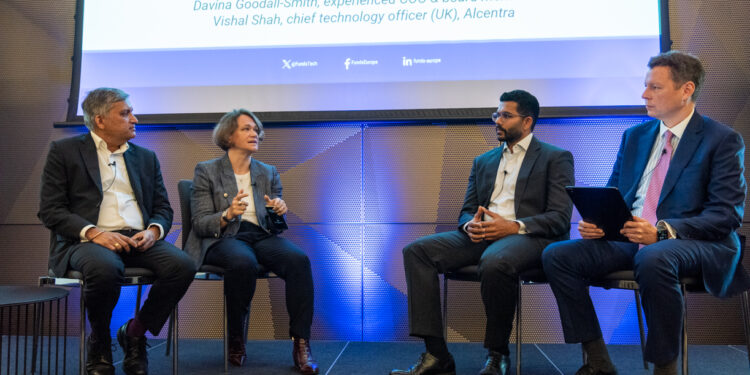
The panel was moderated by Nick Dekker, senior partner and head of technology consulting UK at Alpha FMC. Panellists included Davina Goodall-Smith, chief operating officer, board member and ESG advocate; Sachin Anandikar, chief technology officer at Pemberton Asset Management and Vishal Shah, chief technology officer at Alcentra.
Do senior leaders recognise need for transformation? Moderator Nick Dekker asked the panellists. According to Davina Goodall-Smith, the perspective of the COO role is evolving. It’s about maintaining relevance, she noted, highlighting that fintech innovation and increasingly tech-savvy client demands are reshaping operational priorities. “The right technology is critical — not just for scaling into new geographies but also for supporting new products,” she added.
Addressing a question from Nick Dekker about tensions between boards and visionary change leaders leading to “fear of falling behind – a kind of Fear of missing out” at board level, Goodall-Smith said the idea that boards are only focused on risk, stressing that they are ultimately responsible for the business’s resilience and long-term success.
As both a COO and CTO, she emphasised: “It’s about doing things for the right reasons. I don’t think any business today is doing tech for the sake of it anymore — it’s about ensuring transformation remains relevant to business needs.” She underlined that clear communication is a “massive” part of this process.
Balancing innovation & ESG – Davina Goodall-Smith at FundsTech Forum 2025
Goodall-Smith warned asset managers against rushing into AI implementations just to keep pace with market hype. “The real risk is rushing the AI story,” she said. It is critical, she stressed, to understand the underlying technology properly. “Education at board level is essential — transparency, ethics, bias — these issues must be fully considered. The biggest mistake would be to rush AI without a proper feedback and control loop.”
On vendor relationships, Goodall-Smith said true partnerships are now more important than ever. “It’s not just about outsourcing anymore; it’s about finding providers who genuinely add value.” Differentiating front-to-back systems has become a key market advantage, she added.
She also noted that “both the CTO and COO roles are not what they were 10 or 20 years ago.” Today, the boundaries are blurred and the two functions are beginning to merge.” Technology and operations are growing together, and in her view, “the journey is becoming easier.”
Cultural factors also play a major role when operating globally, she highlighted. From personal experience, Goodall-Smith observed regional differences in risk appetite: “Japan tends to be much more risk-averse compared to the West, for instance.”
Finally, she said one of the biggest challenges for boards today is grappling with fragmented tech stacks and the complexity of multiple outsourced providers and data sources. “There’s a massive data challenge around establishing a single source of truth. Figuring out how to present that to regulators is one of the hardest tasks boards face,” she concluded.
Alcentra speaks on tech innovation at FundsTech Forum 2025
Sachin Anandikar, chief technology officer at Pemberton Asset Management, said that for firms like his, particularly in private debt, the focus today is clear: “It’s all about operational efficiency.” Sharing his experience leading AI initiatives at Pemberton, Anandikar emphasised that true AI transformation starts with identifying practical use cases.
“We did an initial marketing push with AI,” Anandikar explained. “Resistance to change is common in banks and asset managers, but by finding real use cases, taking them to the board and CEO, and getting them prioritised, we could show early victories — and build on them.”
Anandikar also stressed that CTOs and COOs must focus on where true value lies. He noted that while banks have operated under stable, heavily regulated frameworks for a long time, asset managers face a different challenge. “Asset managers are like a multi-balance sheet bank,” he said, pointing out that the reporting burden is far greater and necessitates building systems from scratch to manage it.
He added that while banks benefit from stronger change management disciplines, the same is not always true for asset managers. The difference, according to him, often slows the pace of innovation. “Embracing innovation is a challenge that banks have not had to deal with in the same way.”
When it comes to outsourcing, Anandikar commented that firms must assess potential partners based on clear criteria: “scale, cost, and the ability to manage new information.” Evaluating outsourcing opportunities through this lens, he argued, ensures that any external relationships genuinely support operational improvements.
Highlighting the growing importance of people as catalysts for change, he added that more tech-savvy individuals within firms are becoming champions of change, underlining that having the right people internally is as crucial as having the right technology externally.
Vishal Shah said one trend often overlooked is how technology skillsets have dramatically shifted since 2020. “During the Covid era, there was a big tech shift. That made cloud expertise, running on-prem services and automation skills critical. Fast forward to 2025 and now it’s all about data analytics and AI.”
The pressure on COOs has intensified, according to Shah, with many now asking bigger questions about transformation. “It’s not just tweaking processes anymore; the entire tech platform needs to evolve,” he added.
On Dekker’s question exploring the tension between boards and visionary change leaders, Shah pointed out the delicate balance between presenting clear use cases and demonstrating positive value. “Board control is vital, but value is also tied to resource costs, time and effort, and perceived efficiency from different offices,” he said. “It’s subjective — can you really put a monetary figure on it? It’s difficult.”
Shah also flagged talent retention as a growing issue in the AI era. “There’s a need to bring in external staff for specific needs, but at the same time, everyone within the organisation must have a basic understanding of how AI works. Education is critical — you have to take people on the journey of using AI safely, with proper tech guardrails.”
Discussing vendor strategy, Shah shared that Alcentra prefers a nimble approach. “We like to decouple from vendors where possible to stay flexible,” he said. However, he added that for specialised functions such as regulatory reporting, outsourcing remains an important tool.
The panellists concluded that the relationship between COO and CTOs is likely to assume a “symbiotic” nature in the times ahead.