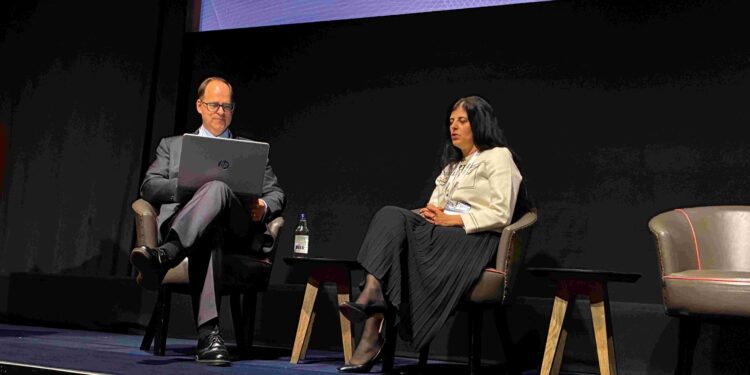
Artificial intelligence is rapidly transforming the economics and operating models of asset management, yet its most profound impact may lie in augmenting — not replacing — the human relationships at the heart of fund distribution, according to Maryse Medawar, head of sustainability at Longview Partners.
In an onstage interview this morning at the FundsTech 2026 conference in London , Medawar argued that mounting cost pressures and tighter margins are pushing firms to rethink how they deploy technology. “AI is no longer just a technology question: it’s becoming a business model question,” she said, highlighting its potential to drive efficiency across portfolio management, operations and client-facing functions.
Within distribution, however, the shift is more nuanced. While AI can automate repeatable tasks such as client targeting, segmentation and content personalisation, Medawar stressed that trust-based client relationships remain difficult to replicate. “The opportunity is not about replacing the relationship manager, but making them more effective,” she noted.
Asset managers are already deploying AI to analyse large internal datasets, with Longview experimenting with AI “agents” capable of processing millions of data points to support investment decisions, effectively acting as junior analysts. The success of such tools, Medawar added, depends heavily on the quality and structure of underlying data, which can reduce errors and improve outputs.
Despite rapid technological advances, she does not expect immediate workforce reductions in distribution teams. Implementation remains constrained by governance requirements and the need to integrate AI alongside existing controls. In periods of market stress, firms often expand distribution capacity rather than cut it, reflecting the continued importance of client engagement.
Looking ahead, AI could sharpen competitive dynamics by enabling firms to anticipate client behaviour and engagement patterns more precisely. This may favour nimble boutique managers, which can adopt new tools more quickly, although any early advantage is likely to erode as adoption becomes widespread.
For active managers, AI offers a potential lifeline in the long-running battle against passive strategies. By improving efficiency and scalability, it could help justify fees and sustain margins. “It should make the active model more cost effective and competitive,” Medawar said.
Ultimately, she believes success will hinge on combining high-quality data, AI capabilities and human judgement. Firms must also ensure organisation-wide engagement with AI, while keeping the client perspective central to implementation.
“The goal is to serve clients better,” Medawar concluded, underscoring that even in a digital-first era, the human element remains indispensable.