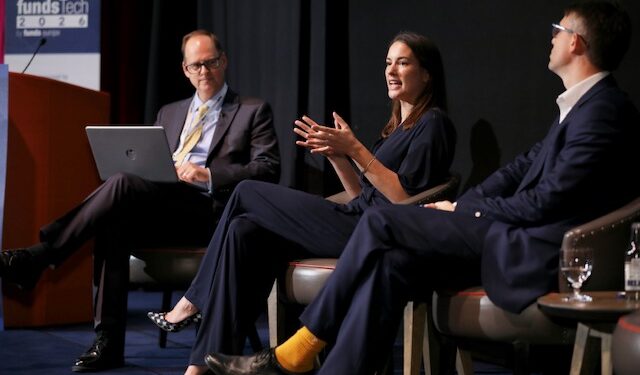
Today’s FundsTech 2026 panel, ‘Private vs public blockchain, choices in DLT strategy, and the implications for fractionalisation and tokenisation’ focused on a question for European asset managers: how tokenisation could reshape access to investments and redefine the industry’s core product structures.
For Alastair Sewell, liquidity investment strategist, Aviva Investors, tokenisation represents an evolution rather than a disruption. Drawing parallels with the origins of mutual funds, he raised the question: “What is the fundamental purpose? It enables access.” In that sense, tokenisation mirrors the role mutual funds played historically, but with a difference: it can break down minimum investment thresholds in private markets.
By enabling assets such as private equity or private credit to be divided into smaller, transferable units, tokenisation could unlock access for a wider pool of investors. “It can be fractionalised to the point of allowing access,” Sewell said, while also introducing transferability that is mostly absent in today’s private market structures. This, according to him, could make tokenisation as a “key unlocking technology” for asset managers looking to expand distribution.
However, he pointed to money market funds as the current “locus of innovation”, where tokenisation is already being deployed in live environments. These use cases, according to him, provide the “lived experience” the industry needs to move beyond theory and into scalable implementation.
Catriona Kellas, international legal lead, digital projects, Franklin Templeton, agreed, highlighting how functionality—not just digitisation—drives value. Tokenised money market funds become more useful when paired with features such as instant transfers and intraday liquidity. “Suddenly, you saw the money market fund become much more useful,” she said, particularly in areas like treasury management and collateralisation.
Kellas described the digital wallet as becoming the “centre of gravity” in this new ecosystem, potentially giving investment advisers a holistic, real-time view of client assets. This shift could deepen relationships between investors and asset managers as clients gain more flexibility in how they use their holdings.
Both panellists stressed that structural challenges remain. While tokenisation is gaining traction, regulatory fragmentation continues to slow progress. Kellas said that asset managers still operate in a “siloed world” across jurisdictions, complicating cross-border distribution. The lack of clarity around how tokenised instruments differ from cryptoassets adds to the complexity.
Sewell also pointed to differing approaches between key European domiciles such as Luxembourg and Ireland, which he described as “money market fund hubs in Europe”. These inconsistencies create practical hurdles for global firms attempting to scale tokenised products across markets.
“European asset management jurisdictions looking to cooperate with others, welcoming talent and being flexible enough to coordinate with other jurisdictions to push for achieving global standards are going to be crucial to pushing the industry forward,” said Kellas.
Despite these barriers, tokenisation is now a board-level discussion within large asset managers, indicating that “future clients” will demand different forms of access and engagement than today’s clients. said Sewell. “The real question is no longer whether tokenisation will happen, but whether it’s going to happen to you, or because of you,” he concluded.