
The UK Accelerated Settlement Taskforce is releasing target settlement rates ahead of the T+1 implementation deadline, as it continues to monitor industry progress while aiming to avoid an increase in settlement fails after the transition from T+2.
Calculations of the target will be based on the market average from the three months prior, in line with recommendation SETT04, outlined in the Taskforce’s Final Report published in 2025.
This will be based on CREST settlement data rather than predefined or theoretical benchmarks, the Taskforce noted, ahead of 2027, when it will start publishing rolling 3-month average settlement rates to act as a benchmark before October 2027.
Andrew Douglas, Chair of the Accelerated Settlement Taskforce, commented: “Providing a target settlement rate will be an essential North Star for the industry to work towards. Ensuring that the market maintains its current settlement success rate once we move into a T+1 world will be a key measurement of the success of the transition overall.”
“To achieve this, I would restate that firms must take action now and hit the milestones set out in the Implementation Plan of February 2025. Automation is the most important piece of the puzzle in helping firms to meet shorter settlement deadlines successfully, enabling them to process trades, data and compliance checks faster than ever.”
Commenting further, Douglas noted that the UK would benefit from the relative openness of data being put forward, which could serve as a benchmark for those in scope of the change ahead. The Taskforce website currently features ongoing publication of settlement rates.
“The idea behind that is to look and see how far we have to go in order to make the transition work.”
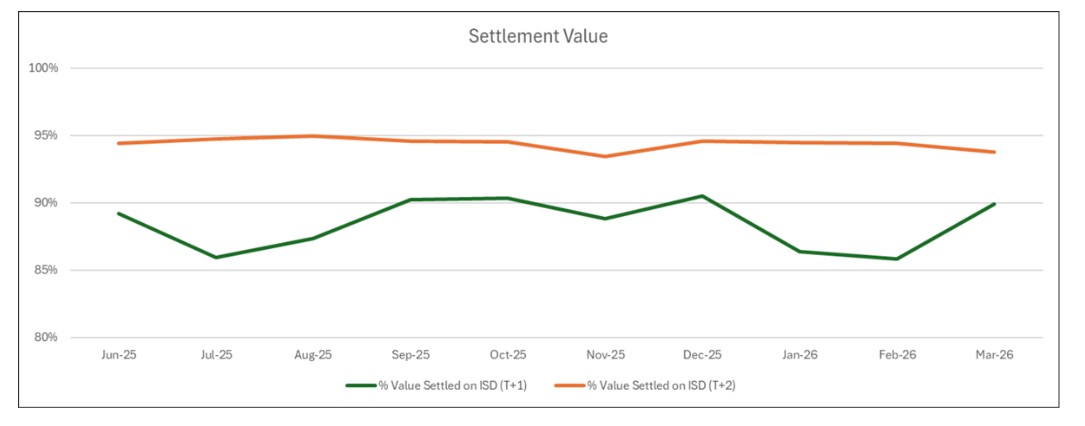
“What I’ve been saying to people is focus on the 16% or 17% of your transactions, which are not in CREST by 05.59 or T+1 and work out why. Failure concentrated in a small number of counterparties means people need to be brutal about who they are going to do business with in future. What this settlement target will provide is a benchmark for any firm operating in the UK.”
Those not meeting the average settlement rate they can ask themselves why not, in mind of counterparties starting to ask questions those constantly incurring settlement fines, Douglas added.
“I would suggest that from the beginning of next year, when the data is aggregated into rolling three month averages, you start looking at your own rolling three month average.”
Commenting further on T+1 beyond its implementation by 2027, Douglas added that the value to be gained at a broader level was its spur to efficiency of UK plc, which could help attract investment.
The latest announcement follows a letter sent by the AST to those in scope in early May this year, detailing recommendations expected to be completed by the end of December 2026. The letter outlined details regarding settlement, static data and securities financing.