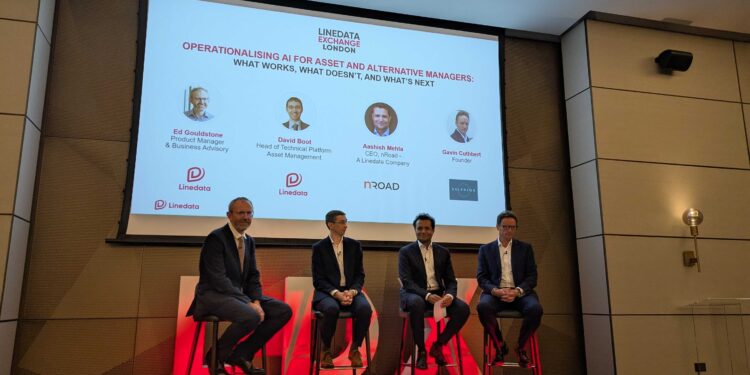
With “Operationalising AI for Asset and Alternative Managers” as a theme, a session at the Linedata Exchange Northern Europe 2025, held on June 5, took a practical look at how AI is reshaping asset management in 2025.
The panel was moderated by Ed Gouldstone, product manager & business advisory at asset management tech provider Linedata and attended by David Boot, head of technical platform, asset management, Linedata, Aashish Mehta, CEO at data business nRoad and Gavin Cuthbert, founder at consultancy firm Delphiqa.
David Boot noted that the “sweet spot” for AI’s current capabilities lies in discrete tasks—particularly those taking less than 30 minutes. “AI can outperform humans in small, self-contained functions, but it still struggles with long-horizon, interconnected problems,” he noted.
Gavin Cuthbert emphasised the value of AI tools for developers and technical staff. However, he also highlighted the importance of avoiding over-reliance in a regulated industry such as asset management, citing risks around Chat GPT and the potential for divergence in output quality when tools are used improperly or without guardrails. “Feedback loops, transparency and clarity around data use and model training are critical if asset management firms want to scale AI usage effectively,” said Cuthbert.
REGISTER NOW: AI and the Future of Sustainable Investment
Aashish Mehta distinguished between enterprise and consumer use of AI. In the asset management context, he identified three major enterprise concerns: compliance, disclosure and cost. AI must navigate these hurdles before being deployed widely, particularly in regulated environments. “The cost of mistakes is too high in financial services,” Mehta added. “Agent-based AI is promising, but we’re not yet ready to trust it with a core portfolio or regulatory tasks without human oversight.”
As for adoption trends, the panellists observed a generational and cultural divide. Enthusiasts—those who are naturally tech-savvy—are extracting the most value from AI. Yet for wider adoption, training and organisational policy will be essential.
The discussion also touched upon the future of generative and agentic AI, artificial intelligence systems designed to operate autonomously, making decisions and taking actions without direct human intervention. While GPT-style models are rapidly improving, their ability to handle larger, more complex datasets remains limited.
From improving compliance document parsing to automating pitchbook creation and report generation, according to the panellists, the next wave of AI in asset management is likely to be domain-specific, modular and tightly integrated into workflows.
“The best approach is to start with a small model and incrementally train it on your own data to handle confidentiality threats. That ensures enterprise knowledge building in the AI model,” said Mehta.
Over the next few years, AI models will increasingly move beyond being standalone tools and become more integrated into everyday workflows—accessing databases, documents, emails and other parts of your ecosystem. The panel concluded that this deeper integration, combined with access to richer data, will enable them to take on more complex tasks and create new job opportunities.