Latin America is strongly associated with debt default, yet fixed income investors have flocked to government bonds there in recent years, particularly Brazil. Nick Fitzpatrick speaks to fund managers about the background to this move and asks if the money will stick.
The Mexican drug wars that have raged in the north of the country and claimed the lives of thousands of people in just a few years look like the Latin America of old. Armed thugs, violence, terror, and blood on the streets are all echoes of the continent in the final decades of the 20th century.
Move further south and there is another reminder: the grinning Hugo Chávez, president of Venezuela, is a throwback to the populist governments of the same era, as are his economic policies, described as “ridiculous” by one fund manager.
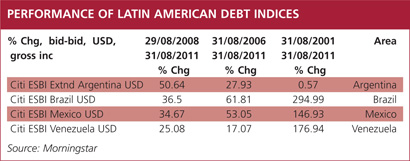
Yet the continent has changed sufficiently in the past ten years to attract more long-term fixed income investors. As the uncertainty about markets grew following the sub-prime failure of 2007, international investors have flocked to Brazilian government bonds.
No doubt they have converged on other unusual ports of stability, too. But to invest money at a time of financial stress in government debt on a continent that in recent decades was probably most associated with debt default is not so much a sign of how shaky Western economies have become, but how deep that change has been.
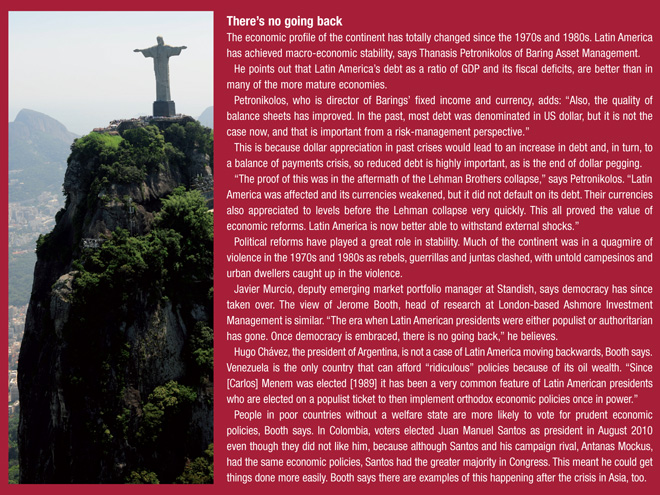
It is Brazil above all other countries in the region that demonstrates the contrast with the past. Although it contributed greatly to the fraught Latin American story of the last few decades – being no stranger to rampant inflation and currency crises – economic reforms have changed the face of Brazil and other nations on the continent.
The democracies that have replaced juntas have reduced political risk for investors, too.
Even the violence in Mexico has a different tint than the violence in Latin America’s past, exactly because it is devoid of political ambition. In previous decades, gangs financed by drug cartels, such as Peru’s revolutionary Farc movement, had political motivations.
Javier Murcio, deputy emerging market portfolio manager at Standish, a Boston-based manager that invests in local currency and dollar government debt in the region, says this is no longer true of Mexico’s cartels. “In the past, guerrilla movements presented a political risk, but this is not the case anymore. The violent drug cartels in Mexico are not trying to take power like these movements were.” He points out that foreign direct investment in the country is highest in some of the regions most affected by the violence.
Defying expectations
International investors are now more prepared to lend their money to emerging market governments, and Latin America is no exception. They see either a relative stability in local currency debt in places like Brazil, or for those prepared to risk flashpoints such as Venezuela, a yield that compensates them.
Brazilian bonds saw inflows at around the time that Lehman Brothers collapsed in 2008, and they continued to increase afterwards. Investors had noticed something: no matter how bad things became in the months and years that followed the banking crisis, Mexico and Brazil, the two largest economies in the region, did not default on their debts, despite expectations that they would.
It was the fall in commodity prices that had led some investors to fear a default, but it had perhaps slipped many people’s attention that since democracy began to prevail in the 1990s and economic policies became more orthodox, neither of the two economies were any longer at the mercy of hard currency commodity exports as they had been in the past.
Alexander Gorra, senior strategist at BNY Mellon Arx, and based in Rio de Janeiro, says: “There was a lot of concern that commodity prices would collapse in Brazil and Mexico [in 2008]. But commodities in Brazil are only 10% of the economy. The engine of growth is the domestic economy.”
Murcio adds: “Oil was a much larger share of Mexico’s exports 20 years ago, but may be less than 10 to 20% now.”
He points out that manufactured exports from Mexico have increased tremendously, and in Chile, which used to export mostly raw materials, there is now an agro-industry and more manufacturing. Meanwhile, in Peru, there has been a significant growth in textile exports.
It was similar in Brazil which, by the time of the financial crash, had diversified its industries and was nurturing a growing middle class. In fact, that is partly what made it eligible in 2001 for membership to the club for newly advanced nations, the Brics (Brazil, Russia, India and China).
These days, Brazil is running a surplus.
No longer the debtors
Jerome Booth, head of research at London-based Ashmore Investment Management, says: “Latin American countries are now net creditors, not debtors like before. Everyone owes them money, not the other way around.
If you cut Brazil off from capital, it will not default. You can’t say that about France or the US any longer, and because it is the same in many other emerging markets, there is no risk of contagion.”
Before the Lehman collapse, 70% of cross-border finance for Latin America came from Europe or the United States, Booth says. After the crisis, there was something of a role reversal with 70% of this finance coming from Latin American banks and the rest from elsewhere.
 Which brings us back to the international investors in Brazil’s government debt. They held 1.55% of Brazil’s public debt at the beginning of 2007. At the end of 2008, the year of the Lehman collapse, that was 7.17%, and at the end of August this year they held 11.75% of
Brazil’s R1,693 billion (€675 billion) public debt, according to the Brazilian National Treasury.
The outlook
Latin American local currency sovereign bonds are a “significant” component of Barings’ local currency debt product, which has sizeable exposures to Colombia, Brazil and Mexico. There is the potential for high risk-adjusted returns, says Thanasis Petroniklos, director of Baring Asset Management’s fixed income and currency.
But what about volatility? How long until the recent wave of international investors exit the continent?
Murcio and Booth say investors in Latin American fixed income are increasingly long-term in nature. “We are seeing some large institutional investors make strategic allocations to Latin American debt, in some cases 5% of the entire portfolio,” says Murcio.
These investors tend to be mainly Asian and European, he says, though Canada and the US are also showing more interest.
In Brazil, there have been measures this year to encourage longer term investors and discourage shorter term “carry” traders. Carry traders play interest-rate differentials, borrowing money where rates are low, and investing it in higher yielding countries.
Gorra says this has improved the quality of capital entering Brazil. More than half the inflow over the past twelve months has been foreign direct investment, which is generally long-term and not taxed. Taxes of 2% on equities and 6% on fixed income encourage those investors to stay longer in the market.
“It’s proved to be relatively successful in lowering volatility.”
The shifting pendulum of economic strength from developed world to emerging markets is encapsulated nicely in the pattern of investment in emerging market local currency debt. US treasuries did receive inflows after the country was downgraded by Standard & Poor’s, a credit rating agency, but local currency debt has helped those that wanted to avoid the weakening dollar.
For some investors, though, Latin American sovereign debt is arguably the best in the emerging market universe. “We say that Latin American sovereign debt is an alternative for all fixed income, not just US treasuries,” says Booth.
©2011 funds global