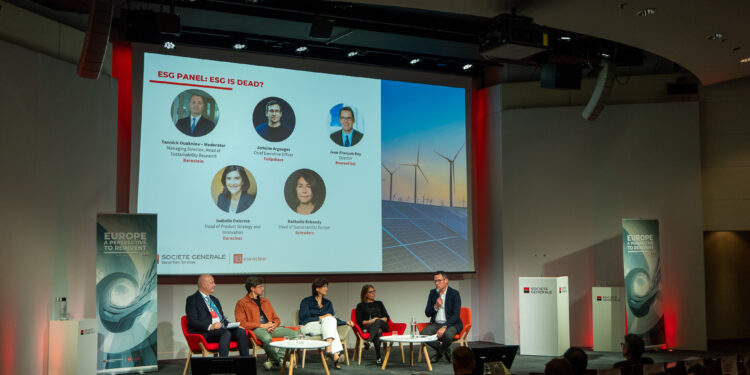
If the perceived decline of ESG funds is to be reversed, asset managers need to increase their engagement with their portfolio companies.
This was the main takeaway from a panel on the future of sustainable investing at the European Investor Summit held by Societe Generale Securities Services in Paris this week.
The panel of European asset managers laid out a number of ailments in the green finance market, from the political backlash led by the US to the complexity of the labelling regime to the funds’ lack of tangible impact.
But, according to Antoine Argouges, CEO of US-based activist investor Tulipshare, it is engagement and stewardship that should be front and centre of any sustainable investment strategy.
“If you do not meet your portfolio companies, who are you to tell that company how it should be run?” said Argouges.
It has been a volatile time for ESG funds. Since the EU’s introduction of its greenwashing rules, the Sustainable Finance Disclosure Regime, in May 2024, the number of European funds with sustainability-related names has dropped by a fifth, according to data provider MSCI.
There has also been a political backlash against sustainability and net zero initiatives, led bv the current US administration. Yet despite this, the use of renewable energy has continued to rise.
As Jean-Francois Bay, director of BoursoFirst, pointed out, in the first half of this year, renewable energy overtook coal as the world’s leading source of electricity for the first time ever.
Engagement and stewardship will therefore be key to overcoming the political and cultural obstacles said Argouges.
“The US administration is not helping but it is our responsibility as an asset manager to be clever about engagement,” said Argouges. “All sustainability initiatives will be politicised, that is the world in which we have to play.”
Consequently, Argouges envisages there will be a separation of active and passive in ESG. “The asset managers that engage with their portfolio companies will do better than the ones that hide behind proxy voting and let the market decide a company’s voting policies.”
According to Nathaele Rebondy, head of sustainability Europe at Schroders, there is evidence that engagement does work. “Those companies we engaged with were more likely to set transition targets and more likely to outperform in the first and second year of that journey.”
However, what is really needed is clear evidence that ESG funds work in terms of generating returns. “Investors have been disappointed by the lack of impact from their ESG funds, so that ability to show tangible impact is going to be critical,” said Argouges. “It is about proving that you have put your money where your mouth is.”
As a result, more reliable data will be integral to the evolution of sustainable investing. “SFDR, CSRD, SRI … The jargon around ESG is not really important and having an ‘ESG fund’ doesn’t mean much to investors,” said Bay. “If we are to successfully reinvent the ESG market, we need to use the data better and convert it into effective and adaptive products.”
“Clearly, we are in a new phase, said Isabelle Delorme, head of product strategy and innovation at Euroclear. “There is a clear demand for reliable, structured data. The days of just sticking a green label on a fund is over.”