The future of asset management may arrive sooner and more radically than many expect, according to Borno Janekovic, chief executive of Omphalos Fund, who argues that machines have already begun to replace traditional portfolio managers.
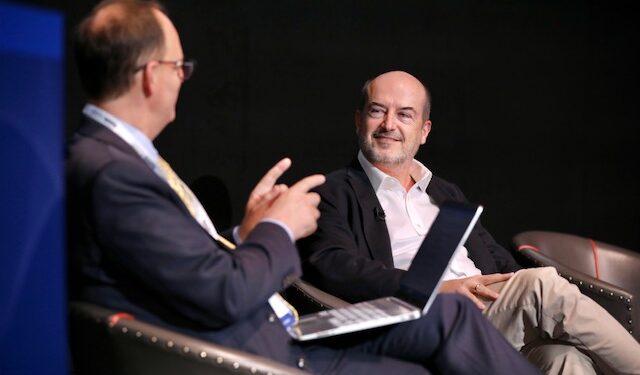
Janekovic’s firm operates a multi-strategy, multi-asset hedge fund model without human traders. Instead, it deploys more than 1,000 algorithmic “agents” that autonomously generate trading decisions, with new strategies continuously created and tested through machine learning. “We have taken the traditional model and taken the people out of it,” he said during a fireside chat at the FundsTech 2026 conference in London.
Unlike conventional quant strategies, these systems are not explicitly programmed. Instead, they are trained in simulated environments, executing thousands of trades before only the most successful are deployed into live portfolios. The approach mirrors breakthroughs in artificial intelligence such as AlphaGo’s landmark “Move 37” in 2016, a moment Janekovic describes as the point where machines demonstrated a form of strategic reasoning beyond human intuition.
The result is a scalable “factory” model of asset management, producing dozens of new trading agents each month while discarding underperforming ones. This constant evolution, he argues, is essential in a market where alpha decays rapidly. “You are only as good as you are today—you constantly need to evolve,” he said.
Janekovic believes the next phase of investing will blend traditional fundamental analysis with advanced machine learning, a concept he terms “quantamental”. Small improvements in predictive accuracy — often just a few percentage points — can produce outsized returns, highlighting the importance of data and computational power.
Yet the implications extend far beyond investment performance. Automation is already reshaping the workforce, reducing demand for junior roles and increasing productivity among remaining staff. Over time, Janekovic expects a significant contraction in headcount across the industry, as machine-driven models scale with minimal human input.
“We have 35 people running a fund that can manage billions,” he said, contrasting this with traditional firms reliant on large teams.
The shift also underscores a broader transformation: asset managers are becoming technology companies. Firms that fail to own and develop their own technology risk falling behind more agile competitors. “If you want to compete in the future, you need to own the tech,” Janekovic warned.
Despite the disruption, he does not foresee the immediate disappearance of traditional approaches. Human-led strategies will persist where they continue to deliver returns. However, those that fail to outperform benchmarks face increasing pressure from both passive products and AI-driven competitors.
For new entrants, the message is clear: technical skills and adaptability are paramount. For incumbents, the choice is starker—adapt or risk obsolescence in an industry being rapidly redefined by machines.
“The machines are coming,” Janekovic said. “And they are getting better every day.”