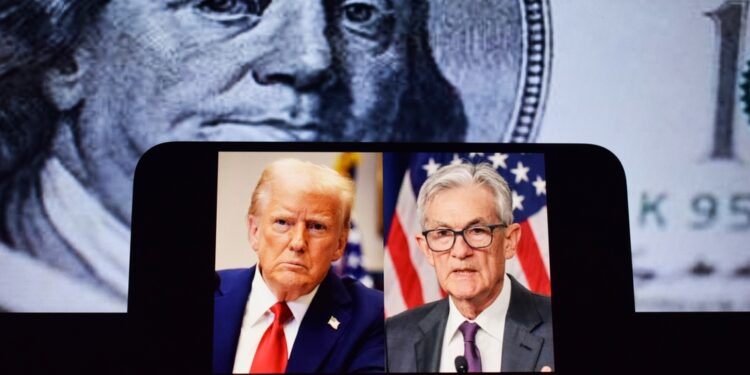
Gold surged to a fresh all-time high and the dollar weakened after weekend tensions between the White House and the Federal Reserve escalated, pushing investors toward assets seen as sitting beyond political influence.
The market reaction followed a video statement from US Federal Reserve Chair Jerome Powell, who said personal subpoenas from the Department of Justice amounted to an attack on the Fed’s ability to set interest rates independently, “based on evidence and economic conditions”, rather than under what he described as “political pressure or intimidation”.
According to LSEG data, spot gold advanced roughly 2% to trade above $4,600 an ounce for the first time today, with prices up around 6% so far this year. The US dollar fell broadly alongside softer US stock futures and Treasury rally after Powell’s comments on the legal threat (Reuters).
Melanie Baker, senior economist at Royal London Asset Management, said Powell’s remarks were “strong words” that signal “a high level of concern that Federal Reserve monetary policy independence is under threat,” coming amid repeated criticism from Trump, calls for presidential input on rates and a separate legal case brought against Fed Governor Lisa Cook over alleged mortgage fraud. “Threats to monetary policy independence can have significant market and economic consequences,” she warned.
Gold reached a new record high and the dollar slipped against major peers, showing a lack of stability over policy uncertainty at the heart of the global financial system. Trading firm IG’s chief market analyst Chris Beauchamp pointed to gold’s rally and weaker US futures as early signs of stress, adding that while earnings season could temporarily knock the story off the front page, it was unlikely to go away. “This certainly wasn’t on our bingo card for 2026, but it represents a major crisis for markets and has the potential to restart worries about the dollar and US monetary policy,” Beauchamp said. “It will now rumble along in the background.”
With President Donald Trump also weighing fiscal measures that would expand the deficit, Butcher said markets are likely to raise questions about fiscal dominance, alongside a tail risk that yield curve control could re-enter the policy debate, highlighted Jon Butcher, senior US economist at Aberdeen.
“For investors, this raises fear that the Federal Reserve’s decades-long independence is at risk,” Bailey said. “This potentially undermines the credibility of the dollar and dollar-denominated assets, increasing the appeal of gold,” said Tom Bailey, head of research at ETF provider HANetf.
The rally builds on gold’s strong multi-year performance, with the metal having outperformed equities in both 2024 and 2025, Bailey added. While it is still early to conclude for the year ahead, he said the combination of Fed independence concerns and elevated geopolitical risk continues to provide a supportive backdrop.
Susannah Streeter, chief investment strategist at financial advisory service Wealth Club, pointed to tensions in the Middle East, where speculation over US action against Iran could broader instability, pushing oil prices higher and making energy markets volatile — a combination that complicates the inflation outlook amid doubts on the central bank’s independence.
Some strategists point to a broader shift in how markets hedge political and institutional risk. Nigel Green, chief executive of deVere Group, said investors see a deeper issue than a simple policy disagreement. “Pressure on the central bank of the world’s largest economy carries global consequences,” Green said. “When that confidence weakens, capital moves quickly into assets designed to exist beyond political reach.”
Bitcoin, Green noted, has also risen alongside the other shifts. “Repositioning lifts assets built on independence from political control,” Green said. While gold has traditionally filled that defensive role, he argued that Bitcoin increasingly shares that space, helped by growing institutional adoption through spot ETFs and deeper derivatives markets.
Markets, he added, trade on direction rather than verdicts. “Investors don’t wait for courtroom outcomes or formal policy shifts. Perception of direction drives pricing,” Green said.