Macroeconomic trends and geopolitical trends have always impacted the investment world but in recent years this influence appears to have grown significantly.
In the last four years there has been a global pandemic, the outbreak of two conflicts in the Ukraine and the Middle East respectively and an international increase in inflation. And now, in 2024, half the Western world is going or has already gone to the polls for a general election.
Meanwhile, running in the background, is the climate change emergency.
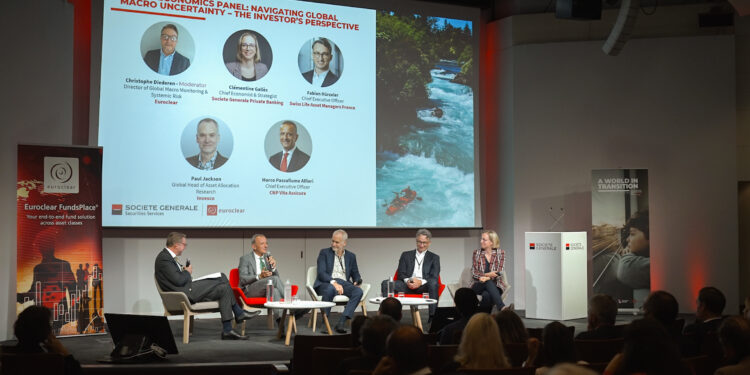
It is no wonder then that macroeconomics was the first subject to be discussed at the European Investment Summit held by Societe Generale Securities Services held in Paris this October.
The US presidential race was the first topic for discussion with the audience asked to vote on who was most likely to win the November election – a decision that came out marginally in favour of Kamala Harris. The audience’s view was shared by Paul Jackson, global head of asset allocation research at Invesco. “It is advantage Harris at the moment, she has more pathways to the White House. She is ahead in three swing states and behind in two. There are two very important swing states – Nevada and North Carolina.”
In Europe, the UK and France have both already had their general elections. The UK voted out the incumbent Conservative government after 14 years, while Macron survived the possibility of a government from the extreme left or extreme right.
However, Jackson told the audience that it may be just a matter of time before a far-right candidate take the presidency in France amid an increasingly volatile political climate across Europe.
Geopolitical uncertainty
The economic impact on French stocks and markets may be limited, said Jackson. It is more the fear that he is out of step with public opinion and the uncertainty that this brings, which in turn calls for more portfolio diversification. The election of Trump in 2016 as well as the Brexit vote in the UK were examples of this fear.
“Economists need to accept that they are likely to be wrong 50% of the time. The problem right now is that it is impossible to tell which half, which begs the case for diversification”
Paul Jackson, global head of asset allocation research, Invesco
More recently, a poll of US voters found that 42% believe the world is controlled by a small global elite, which Jackson described as “very worrying”. “Economists need to accept that they are likely to be wrong 50% of the time,” said Jackson. “The problem right now is that it is impossible to tell which half, which begs the case for diversification.”
As Marco Passafiume Alfieri, chief executive officer, at Italian life insurer CNP Vita Assicura, said: geopolitics is “very scary” but at least for the moment it has a minimal impact on stock prices and securities markets, even if a recent poll of Italian investors showed that geopolitical uncertainty was ranked as the number one influence on asset allocation. “It is more about the economy and central bank intervention,” said Passafiume Alfieri.
Inflation has been the big concern for Clementine Galles, chief economist and strategist, Societe Generale Private Banking. While it was inevitable that there would be an inflationary shock after the government spending during the Covid pandemic, it still had a significant macroeconomic impact, “The inflation shock was everywhere and while the rate of inflation is easing, the shocks are still there,” said Galles.
Interest rates remain high in the US and in Europe where there has been a negative supply shock and question marks about Europe’s growth prospects, which, says Galles, will have implications for savers in Europe.
The panel also discussed demographic developments and their impact on the investment world. As Passafiume Alfieri said, demographics is at the heart of the life insurance business. “Actuaries have to radically change their assumptions around longevity risk. A key issue is how our clients can live beyond their savings. It changes the structure of the liabilities and the investment horizon of the assets for a Life Insurance Company, so we need to monitor these developments.”
Demographics were also discussed in the keynote interview with Valerie Baudson, chief executive of Amundi, Europe’s largest asset manager.
“Not all of the macroeconomic and socioeconomic trends are negative,” said Baudson. “For example, the ageing population is great news for the asset management industry, even if it may not be great news for society at large.”
Similarly, economic growth may be slower than we are used to but that encourages a savings culture.
According to Jackson, the big demographic trend of the century will be the rise of Africa. “The continent will have a healthy demographic with good working age growth. It is also a good source of clean energy – it has the potential to contribute 30% of the world’s solar and wind power. Africa will be the growth story of the century.”