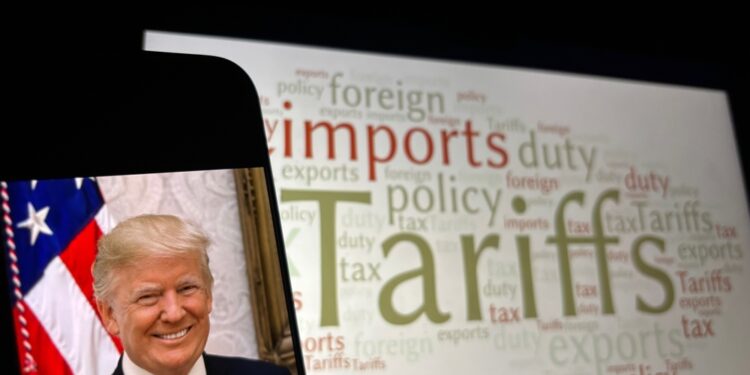
As China retaliates to Donald Trump’s double tariff announcement and as a sell-off in US Treasury bonds accelerates, fund managers have set out their short, mid and long-term priorities.
Paul Diggle, Chief Economist at Aberdeen, said of the US: “US bond yields have started to move sharply higher despite equity market weakness, and the curve has steepened significantly. Falling equities and dollar, and rising yields, represent a pernicious combination. In any other country, this would be called a sovereign crisis.
“This is particularly striking because the US treasury market is meant to be the risk-free asset that performs well when equity markets are falling. Instead, bond yields appear to be rising for several reasons.
“First, uncertainty around US policy means investors require higher term premia (the compensation that investors require for lending for longer periods, which takes the form of higher yields). Indeed, the move in nominal yields – the interest rate before inflation is taken into account – seems to be an increase in term premia rather than inflation compensation, with real yields moving up despite the weaker growth outlook.
“Second, the US may be becoming a structurally less attractive place to invest over the long run, with tariffs reducing long-run potential growth, meaning portfolios could well hold fewer US assets in the future.
“Policy unpredictability and lower growth may also lead to greater concern about fiscal sustainability, with the US less able (and, if certain parts of the Miran plan are implemented, less willing) to service its debt.
Meanwhile Robert Gilhooly, Aberdeen’s Senior Emerging Markets Economist, said of China: “Tariff tit-for-tat between the US and China will almost certainly spur further policy easing by China – such as bond issuance brought forward and expanded – but it is unlikely to be enough to fully offset the shock.
“Higher tariffs on other Asian economies reduce the ability to circumvent tariffs by re-routing goods via third countries, while the scale and breadth of tariffs across both EMs and DMs implies a broad-based global growth slowdown.
For now, we are pencilling in another 1.25% hit to the level of Chinese GDP, which pushes down 2025 GDP growth to 4.2%.
“Tomorrow’s CPI print will be important in judging underlying inflation going into the trade war, but the growth shock combined with the oil price fall will likely keep CPI inflation and the GDP deflator in negative territory.
“The authorities continue to lean against FX depreciation pressure, with the latest reporting suggesting that state-owned banks have been asked to reduce their USD purchases. But, at the same time, the FX fix has been allowed to push higher, while the CNH/USD exchange rate briefly hit a record high of over 7.4 yesterday.”
Over at GIB Asset Management, Kunal Desai, Portfolio Manager and Megan Ie, Senior Equity Analyst of the firm’s Emerging Markets Active Engagement Fund, said of the impacts of US tariffs on China:
“The global trade landscape is becoming increasingly volatile, with escalating tariffs no longer confined to a U.S.-China dispute but extending across multiple regions. Emerging markets (EM) have faced weaker performance, partly due to a higher-than-expected level of reciprocal tariffs.
“Notably, Asian markets are only now reflecting the initial announcement’s impact, as several financial hubs—Taiwan, China, Hong Kong, and Indonesia—were closed last week. The broader risks remain unchanged: disruptions to global supply chains persist, and exporters are unlikely to lower prices in a scenario with limited substitutes. While some emerging economies, particularly those with strong domestic demand like India, Turkey and Indonesia, may be more resilient, the overall environment remains uncertain. There is also the possibility that Trump could use tariffs as a negotiating tool if domestic pressures are tricky to stomach, potentially leading to a watering down of current rates.
“China’s response to the tariffs will be shaped by a combination of policy stimulus and retaliatory measures. The country faces economic headwinds from weak market sentiment, deflationary pressures, and a struggling property sector. If tariffs remain at current or higher levels, Beijing is expected to deploy fiscal support and targeted interventions to sustain GDP growth and meet its 5% annual target. Stimulus efforts will likely be reactive, addressing the economic impact rather than the news itself. If financial markets experience further turmoil, authorities may step in with rate cuts or intervention from state-backed funds.
And Cesar Perez Ruiz, Chief Investment Officer, Pictet Wealth Management, said it would be important to find composure amid the market turmoil.
“The US tariffs announced on 2 April are the biggest trade shock the world has seen in 100 years and the risk of recession in the US has increased substantially,” he said.
“A tectonic shift is underway in the global economy as US policies undermine trust in the world’s largest economy, while a European revival takes hold, and Chinese innovations disrupt markets.
“In the near term, markets will remain volatile and global equities under pressure given the risk of recession. We recommend holding onto safe assets like the CHF and gold, and keeping some powder dry for once the dust settles. In fixed income, the rise in German Bund yields makes them more attractive.”