• Privacy Policy
  • Cookie Policy
  • Funds Global
    • Funds Global Asia
    • Funds Global Mena
    • Funds Tech
SUBSCRIBE
Funds Europe
No Result
View All Result
  • News
    • All news
    • People moves
    • Fund launches
  • Analysis
    • Insights
    • Content Hubs
    • Industry comment
    • Interviews
    • Opinion
    • Roundtable features
    • White paper library
  • Investments
    • Alternatives & private markets
    • Emerging markets
    • Equities
    • ETFs
    • ESG
    • Fixed income
    • Top 200 Fund Managers
  • Asset Servicing
    • Fund administration
    • Distribution
    • Technology
    • Trading
    • Trading & transfer agency
  • Regulation
    • Legal
    • Regulation
  • Reports
    • Industry Reports
    • Research Reports
    • Event Reports
  • Content Hubs
  • Events
    • Funds Europe Awards
    • Industry events
    • Webinars
  • Media
    • Magazines
    • Podcasts
    • Videos
  • About Us
    • Editorial team
    • The Magazine
    • Media Pack
    • Subscribe
    • Write For Us
    • Contact Us
  • Top 200
Funds Europe
No Result
View All Result

ETFS: Cleaving to the benchmark

by Catherine Lafferty
7 September 2017
Yaht
Share on FacebookShare on Twitter

ETFs brought emerging markets within reach of a much wider pool of investors – but what investors get out of these ETFs depends on what the indices contain. Catherine Lafferty looks at two market-leading benchmarks.

ETFs provide a world of choices, not just about which country or sector to invest in, but also from which index to harness performance.

The MSCI Emerging Market (EM) Index is the current undisputed heavyweight champion of emerging market indices listing 23 countries and containing 843 constituents. The numbers will soon grow to include China when A-share stocks are added in June 2018.

According to UBS’s head of ETF sales, Simone Rosti, UBS uses the MSCI index for its emerging market equity ETFs because it is seen as the most representative – due to the large number of constituents – and because it has the longest track record.

The MSCI’s principal rival is the FTSE Emerging Index, which has 990 constituents and 22 countries.

Including active and ETF funds, the MSCI EM NR Index, which provides a net return version, has 3,355 funds benchmarked to it, while the FTSE Emerging Index TR, which measures the total return, has nine funds that use it as a benchmark.

Free-floating
The MSCI EM and FTSE Emerging indices have many similarities: they are both weighted by market capitalisation and work on a free-float adjusted basis, meaning only shares that are readily available for trading are included.

The MSCI and FTSE indices cover a similar list of countries and encompass the large and mid-cap segments of the emerging market stock universe.

The differences between the two are more a matter of fine brushstrokes, such as market coverage. The MSCI EM Index aims to cover 85% of the market, whereas FTSE EM aims to cover 86%; both indices select the largest emerging market companies.

There are some minor differences in country coverage, with the FTSE classifying South Korea as an advanced country while MSCI includes it in the emerging market universe. There are differences in investibility constraints too: MSCI and FTSE use different measures for the investability criteria, and different thresholds. This is probably the main reason why FTSE EM has more companies, despite not including Korea.

China Post Global uses the MSCI for emerging markets and frontier markets. It has also used Dax indices for emerging markets and has three Dax global ETFs.

Danny Dolan, managing director of China Post, says: “We tend to be very agnostic about index selection. We’ve used FTSE for non-EM. For every new ETF we issue, we choose an index and provider with a very open mind, which has resulted in a very varied index list across product range.”

Antoine Lesné, head of ETF strategy and research for Europe, Middle East and Africa at State Street’s SPDR business, says the most important difference between the MSCI and FTSE, both of which deal with large-caps, are the sector weights, because these will be the main drivers of performance.

SPDR’s largest emerging market equity ETF is the SPDR MSCI EM Asia Ucits ETF with $366 million (€308 million) in assets under management.

Edward Lopez, head of ETF product management at Van Eck, which has a fixed income ETF business (and uses the JP Morgan GBI-EM suite of indices for its products), explains that the advantages and disadvantages of a particular index depend on the objectives of the investor. An index should align with an investor’s view of the world, such as which countries are emerging markets.
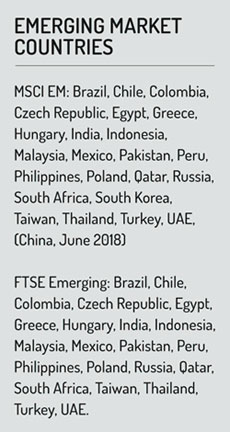
Emeriging_markets_countriesLiquidity and a strong focus on tradability are important for emerging market indices. The weakness for some indices is they are not sufficiently focused on liquidity and they include constituents and currencies that are not tradeable in significant size.

“Focusing on the more liquid, tradeable and accessible part of the market reduces trading costs – but it does mean excluding some countries altogether,” says Lopez.

Market indices are not just a story of strength. In some individual cases, index providers have ended up with aspects of their index that could not be traded, which in turn led some ETFs to close. That is very unwelcome for investors who suffer the risk of not only capital losses, but the inconvenience of finding a replacement index.

Switching indices is more expensive in the emerging market space.

Mark Raes, head of product at BMO Global Asset Management Canada, says: “Emerging markets carry risks with respect to market liquidity and currency, however we deal with these in terms of index design, construction and liquidity tests, whilst at an ETF level the availability of multiple liquidity providers ensures efficient pricing throughout the trading day.”

That there is a proliferation of emerging market indices is perhaps the most eloquent testament to the gathering pace of economic growth in developing markets. Emerging market equities have become more mainstream in investors’ portfolios.

Ten to 15 years ago, fewer funds allowed investors to have such exposure in their portfolios. The emerging markets were hunting territory for active managers, but the advent of ETFs has allowed investors of all kinds, institutional and retail alike, a door into the emerging market equity world.

“There’s been a market love story with emerging markets since the beginning of the year,” says SPDR’s Lesné. “You need to throw a wider net at the investment universe to have the opportunity to generate extra performance. The growth of an equity market is always a function of economic growth.”

©2017 funds europe

Latest from Funds Europe

Getting settlement-ready for Europe T+1

Getting settlement-ready for Europe T+1

25 June 2026
Funds Europe Top 200 and Top 50 2026 published

Funds Europe Top 200 and Top 50 2026 published

25 June 2026
Why ‘jurisdiction’ is a strategy in the new structuring landscape

Why ‘jurisdiction’ is a strategy in the new structuring landscape

25 June 2026
Tycho Capital launches convertible arbitrage Ucits fund

Tycho Capital launches convertible arbitrage Ucits fund

25 June 2026
Build, buy or outsource: what asset managers keep getting wrong about investment accounting technology

Build, buy or outsource: what asset managers keep getting wrong about investment accounting technology

25 June 2026
Rethinking the AI dividend: A framework for institutional investors

Rethinking the AI dividend: A framework for institutional investors

25 June 2026
Next Post
Regulation_burden

SPONSORED FEATURE: Shouldering the burden

Leave a Reply Cancel reply

Your email address will not be published. Required fields are marked *

TOP 200 ASSET MANAGERS REPORT


DOWNLOAD FULL REPORT

ASSET MANAGEMENT: AI & FINCRIME

NEXT GENERATION ETFS

LATEST ISSUE

FUTURE FUNDS LANDSCAPE

VIDEO

LIQUIDITY MANAGEMENT

NEWSLETTER SIGNUP


Join our mailing list to receive our latest news updates, magazine features, thought leadership and market research & analysis.


SUBSCRIBE NOW
  • Contact
  • Editorial team
  • The magazine
  • Privacy Policy
  • Terms & Conditions

© 2026 Funds Europe Limited, a wholly owned subsidiary of Definite Article Media Limited. Website design by Bedazzled Publishing Services Limited.

Add New Playlist

No Result
View All Result
  • News
    • All news
    • People moves
    • Fund launches
  • Analysis
    • Insights
    • Content Hubs
    • Industry comment
    • Interviews
    • Opinion
    • Roundtable features
    • White paper library
  • Investments
    • Alternatives & private markets
    • Emerging markets
    • Equities
    • ETFs
    • ESG
    • Fixed income
    • Top 200 Fund Managers
  • Asset Servicing
    • Fund administration
    • Distribution
    • Technology
    • Trading
    • Trading & transfer agency
  • Regulation
    • Legal
    • Regulation
  • Reports
    • Industry Reports
    • Research Reports
    • Event Reports
  • Content Hubs
  • Events
    • Funds Europe Awards
    • Industry events
    • Webinars
  • Media
    • Magazines
    • Podcasts
    • Videos
  • About Us
    • Editorial team
    • The Magazine
    • Media Pack
    • Subscribe
    • Write For Us
    • Contact Us
  • Top 200

© 2026 Funds Europe Limited, a wholly owned subsidiary of Definite Article Media Limited. Website design by Bedazzled Publishing Services Limited.

No Result
View All Result
  • News
    • All news
    • People moves
    • Fund launches
  • Analysis
    • Insights
    • Content Hubs
    • Industry comment
    • Interviews
    • Opinion
    • Roundtable features
    • White paper library
  • Investments
    • Alternatives & private markets
    • Emerging markets
    • Equities
    • ETFs
    • ESG
    • Fixed income
    • Top 200 Fund Managers
  • Asset Servicing
    • Fund administration
    • Distribution
    • Technology
    • Trading
    • Trading & transfer agency
  • Regulation
    • Legal
    • Regulation
  • Reports
    • Industry Reports
    • Research Reports
    • Event Reports
  • Content Hubs
  • Events
    • Funds Europe Awards
    • Industry events
    • Webinars
  • Media
    • Magazines
    • Podcasts
    • Videos
  • About Us
    • Editorial team
    • The Magazine
    • Media Pack
    • Subscribe
    • Write For Us
    • Contact Us
  • Top 200

© 2026 Funds Europe Limited, a wholly owned subsidiary of Definite Article Media Limited. Website design by Bedazzled Publishing Services Limited.

Add New Playlist

No Result
View All Result
  • News
    • All news
    • People moves
    • Fund launches
  • Analysis
    • Insights
    • Content Hubs
    • Industry comment
    • Interviews
    • Opinion
    • Roundtable features
    • White paper library
  • Investments
    • Alternatives & private markets
    • Emerging markets
    • Equities
    • ETFs
    • ESG
    • Fixed income
    • Top 200 Fund Managers
  • Asset Servicing
    • Fund administration
    • Distribution
    • Technology
    • Trading
    • Trading & transfer agency
  • Regulation
    • Legal
    • Regulation
  • Reports
    • Industry Reports
    • Research Reports
    • Event Reports
  • Content Hubs
  • Events
    • Funds Europe Awards
    • Industry events
    • Webinars
  • Media
    • Magazines
    • Podcasts
    • Videos
  • About Us
    • Editorial team
    • The Magazine
    • Media Pack
    • Subscribe
    • Write For Us
    • Contact Us
  • Top 200

© 2026 Funds Europe Limited, a wholly owned subsidiary of Definite Article Media Limited. Website design by Bedazzled Publishing Services Limited.