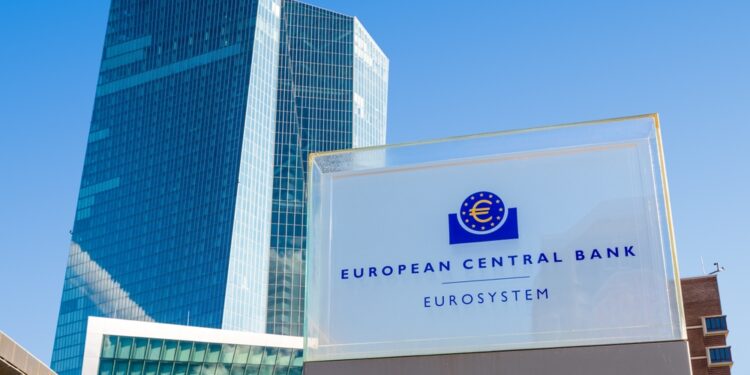
The European Central Bank (ECB) has cut the interest rate by 0.25 percentage points, marking its fourth rate cut in 2024. The move reflected the central bank’s efforts to address easing inflation, slowing growth, and uncertainties in global trade, with experts predicting further cuts in the coming months.
The central bank for the 20 countries that share the euro reduced the rate it pays on bank deposits, which drives financing conditions in the bloc, to 3.0% from 3.25%. It was at a record 4.0% in June.
Simon Dangoor, head of fixed income macro strategies at Goldman Sachs Asset Management, noted that this cut is part of a broader easing cycle. “Following today’s 0.25% cut, we expect the ECB to continue its easing cycle until the policy rate reaches a point below neutral.” While inflation trends are improving, Dangoor emphasised that growth momentum has stalled due to uncertainties in global trade. “The ECB is likely to continue shrinking the size of its balance sheet against a backdrop of increased fiscal issuance, [which] may continue to put pressure on government bond spreads,” said Dangoor.
Inflation excluding energy and food is expected to average 2.9% in 2024, easing to 2.3% in 2025 and stabilising at 1.9% by 2026 and 2027, stated the ECB, adding that inflation is projected to settle around its 2% target “on a sustained basis.”
Konstantin Veit, portfolio manager at Pimco, noted that the ECB’s latest projections, including inaugural 2027 estimates, indicate inflation will stabilise around the target next year despite lingering domestic pressures. He argued that weak growth and inflation near the target support a gradual move toward a neutral policy rate. “Policy rates are likely to continue the descent towards neutral in a gradual fashion,” Veit said, projecting a terminal rate of around 1.75% by late 2025. Decisions will remain data-dependent and made meeting-by-meeting. Veit highlighted the ECB’s ability to manage inflation shocks through slower cuts while using reductions to mitigate downside risks. He also projected weaker growth than the ECB expects, suggesting markets may price in even lower terminal rates.
Ann-Katrin Petersen, chief investment strategist at BlackRock Investment Institute, noted uncertainty about whether the ECB will pause at a neutral 2% policy rate by summer 2025 or shift to a moderately loose stance. She highlighted risks to eurozone growth from potential US trade tariffs, geopolitical fragmentation, and political uncertainty, while persistent domestic price pressures and inflation, projected near or above 2% through 2027, may limit significant easing. “Only a sharp economic deterioration would prompt larger cuts,” Petersen added, pointing to services inflation still high at 3.9% in November. “On a tactical horizon, we prefer income in short-dated euro area bonds and credit, and remain tactically neutral on long-term euro area government bonds. We still favour US stocks over Europe’s on stronger corporate earnings and the artificial intelligence theme – but find opportunities in Europe at the sector or company level.”
Join us on 16th January, 2PM BST (3PM CET) to discover how private markets are poised to transform wealth distribution and shape the future of investing. Register now.
Des Lawrence, senior investment strategist at State Street Global Advisors, pointed to data underscoring the economic slowdown across the Euro Area. He highlighted a broadening deceleration, with the Services Purchasing Managers’ Index entering contractionary territory for the first time since January. “While the annual rate of inflation is expected to move higher in the near term due to base effects, it is projected to return to the ECB’s 2% target next year,” Lawrence said, adding that long-term inflation expectations remain stable. Lawrence expects additional rate cuts of up to 100 basis points by 2025, a view echoed by Daniele Antonucci, CIO at Quintet Private Bank.
Antonucci underscored that the ECB’s dovish turn reflects the challenges ahead. “The ECB has turned more dovish and revised down its growth forecast. There’s more room to cut rates, and we expect the ECB to reduce them to around 2% as inflation normalises,” he said. He also warned of downside risks to the Eurozone’s outlook, including trade tariffs and subdued growth, which could lead to a weaker euro. Like Lawrence, Antonucci sees rate cuts as an opportunity for investment strategies, emphasising increased exposure to short-dated European government bonds that stand to benefit from easing monetary policy.
Kaspar Hense, senior portfolio manager at RBC BlueBay Asset Management, noted that the latest reduction was justified given rising unemployment in core countries and deteriorating global growth. “We expect them to gradually—meaning 25 basis points per meeting—cut rates further to below short-term neutral, which we think is around 2%,” Hense said. He also predicted core inflation to remain sticky at 2.5% in the first half of 2025 before easing in the latter half. “We expect real rates to be negative and mildly supportive of the economy with headwinds from trade, ongoing competing pressure from China and fiscal issues.”
With inflation easing but growth remaining weak, most agree that the ECB is expected to keep cutting rates to steady the Eurozone’s economy.