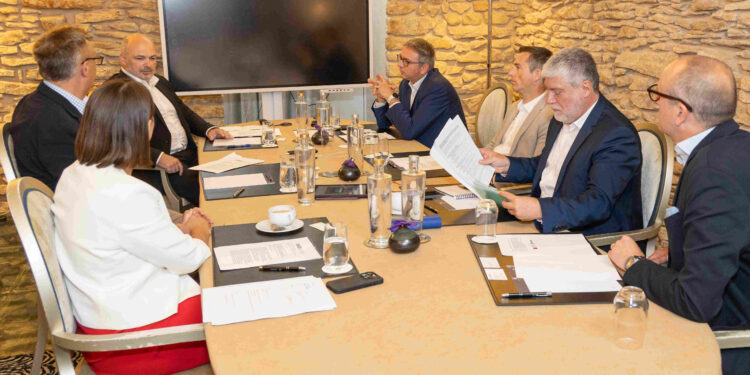
A roundtable of investment professionals held in Luxembourg this summer tackled some of the biggest questions confronting private markets from the impact of AIFMD II and ELTIF 2.0, both launched this year, to considering the impact of falling interest rates and whether that could lead to an uptick in leveraged buyouts and dealmaking.
Opening up private markets to a wider field of investors is an aim has been called the “democratisation” of private markets. The panel began by considering whether more could or should be done to bring more investors to the asset class.
Stéphane Pesch, chief executive of the Luxembourg Private Equity & Venture Capital Association (LPEA), said that the Grand Duchy’s 36 years of experience managing Ucits funds and 20 years of running alternative investment funds (AIFs, starting with the SICAR in 2004) showed that Luxembourg was actively involved in “tackling that democratisation-realisation trend”.
With the launch this year of the EU’s revamped Eltif 2.0 and its toolbox, Luxembourg is well equipped to to encourage and facilitate the access of more investors into private markets, Pesch believes.
“What we would like to underline is that we certainly believe in democratisation, but it should be done with discipline, and it should be done with quality because reputation is at stake,” Pesch told fellow panellists on the high-level dialogue.
“We need to make sure that we have no apprentice sorcerers trying things which do not work: that’s very important.”
Pesch also stressed the need for fund managers to work closely together with asset servicers.
Finbarr Browne, chief executive of Schroders Luxembourg, said the revamped Eltif 2.0 is “one of the key vehicles to put out there, to really scale up democratisation” but its introduction had unfortunately been delayed, creating confusion and uncertainty.
There were also technical aspects to Eltif 2.0, for example on liquidity rules, that needed to be resolved, Browne said.
However, it was not just the Eltif rules themselves that needed to be considered, but also the state of market readiness, which varies from country to country “and even by sector within countries.”
“Service providers are at different levels of readiness for that. And if you’re trying to bring a single client experience to this, it’s challenging because you’re needing to use multiple service providers very often to access these different markets and different sectors,” Browne said. “So the client experience through all this needs to be watched very carefully.”
“There’s also a real need for sales managers to go on an educational journey in terms of changing how they do sales, how they promote the product. Their level of technical knowledge needs to change. Democratisation truly is a journey across the whole industry, for manager, service provider and ultimately the investor as well.”
Raphaël Remond, deputy chief executive of Northern Trust Luxembourg, said that the Grand Duchy’s decades long experience of financial markets should put the country “at the forefront of that ability to educate”.
“Compared to other markets in Europe, Luxembourg is well prepared for that education to happen,” he said.
Camiel de Vries, managing director and head of Benelux & Nordics institutional and wealth at Wellington Management, said it was important, because of the high barriers to entry to private equity, for firms to have specialist salespeople on their teams who can help to demystify the asset class for retail investors.
“As an industry, we also need to be cognisant of the fact that the liquidity needs of the average retail investor are different from institutional investors. Not every individual is comfortable with locking up their money for 10 to 12 years.”
Semi-liquid alts
It was for that reason that Wellington is increasingly looking at semi-liquid alternatives funds, where investors can draw down up to 5% of their investment every quarter. If a private investor gets divorced or needs to help a child through university, it is helpful to have at least some liquidity.
Valerie Tixier, client and market private equity leader at PwC Luxembourg, believes that traditional private equity managers often have less experience of the characteristics and behaviour of retail investors.
Tixier recalled the global financial crisis where 80% of Luxembourg open-ended private equity funds closed as a result of retail investors seeking to redeem their investments in an attempt to minimise their losses. “I hope the lessons have been learned from that time as I don’t want to see history repeat itself,” she said.
“Managers need to find a secure way to properly manage liquidity and liquidity needs and that comes from building up a proper asset mix and propagating sound valuations. When you allow for exits, you allow it at a fair price and that involves lots of covenants, processes, people and tools.”
Louis Lamotte, managing director of JTC Group AIFM Solutions, says that a strong valuation system is necessary once any financial company deals with retail investors.
“I think a proper suitability test should be done upfront to make sure that you attract the right retailers into your assets, into your investment strategy,” he says.
In terms of valuation, we like having an independent appraiser with a strong structured valuation program and not to have valuations done that might change from one case to another.”
The high-level panel proceeded to discuss the impact of the Alternative Investment Fund Manager Directive II (AIFMD2) which entered into force in the spring, as well as the impact of the ELTIF 2.0.
Remond said that the second iteration of AIFMD offered some important extra protections for investors. Firstly, greater transparency on reporting, making sure that the asset manager gives more information about what they do and why they do it and that this will allow investors to better appreciate exactly what is happening within their portfolio.
Marketing rules
The second significant improvement was a tightening of marketing rules, which will help to avoid investors being misinformed and force sellers to be more careful about what they say and do.
Lamotte accepted that the broad aim of AIFMD2, to protect the best interests of the investors, had been achieved. But he also warned that there was a cost implication in introducing new regulation, such as recent new rules on loan origination or the EU’s Digital Operational Resilience Act, known as Dora.
“For third party asset managers from all over the world, Luxembourg is becoming more and more expensive,” he said. “It is becoming very costly to keep an Alternative Investment Fund alive. Sometimes asset managers are wondering, why should I come to Luxembourg to attract potentially new investors?”
Pesch recalled that when the first iteration of AIFMD was launched [in 2013] “many in the industry were initially against it and thought it would harm the market.”
“But in the end it ushered in an entire new ecosystem and the industry would not be there at its current size if the regulation had not been introduced”, he said.
It had led, he said, to an alignment of general partner (GPs) and limited partner (LPs) interests that had been for the “greater good”, more transparency and the crucial EU passport.
“It is important to have good and smart regulation and that is why we consider AIFMD2 more as an evolution rather than as a revolution.
Tixier said she agreed with Pesch’s analysis that AIFMD2 was “by no means a revolution”.
“When you look at the liquidity management tools in it they’re just common sense. These AIFMD2 provisions can be made to work quite easily in my view,” she said.
“After the push of asset managers in the US, we’re back to the initial situation of a disconnect between the levels of regulation for private capital.
“In some ways I wonder if that’s not going to be positive for Luxembourg down the line. Europe is a place where you still need to go if you want to fundraise and you will have to play by the rules at some point. You cannot do private placement as easily as you used to and reverse solicitation is not a distribution strategy by definition.”
Browne also took the view that AIFMD2 is “mostly a step in the right direction”.
“It could again have been a very wrong step, particularly in the world of a delegation of investment management, which Luxembourg lives and breathes by.
“There is some investment management carried out locally, but the vast, vast majority is delegated to different parts of Europe or different parts of the world. So AIFMD2 is getting tougher on outside EU delegation in terms of how you oversee that but thankfully it’s not changing the operating model of asset managers to the extent of saying: ‘now you can do this’.
“Delegation was possibly being questioned at one point, so it’s toned down massively from where it could have gone, which I think is a good reaction from the regulators.”
“In a sense it is regulators pulling the alternatives world closer to the Ucits world, which you can see from increased investor protection, particularly for retail and less sophisticated investors.”
“There are lots of really good reasons for doing that, but there is the risk that it pulls the more pure-play, institutional private market world into a more expensive regime – and that’s the challenge to some degree.
“That is the consequence of trying to do everything right and paint the industry with the same brush but it is a challenge to make directives like this work for everybody: it is a matter of trying to find the right common denominators.”
“It feels like a growing up moment, a kind of a pulling alternatives into the Ucits space but it will make that business more expensive.”
De Vries said it is positive for Luxembourg that there is now an increasing number of GPs that are “actually using Luxembourg vehicles as their global vehicle, rather than just for Europe”.
“Wellington operates in Cayman and Luxembourg, but there are some players who have moved solely to Luxembourg. That would be a great outcome for the Grand Duchy of course.”
Inflation and LBOs
With some market commentators having described inflation as the friend of the leveraged buyout, the panel then considered whether expectations of lower global interest rates would translate this year into an uptick in leveraged buyouts and deals in Europe and globally?
Tixier said that, even without the benefit of a crystal ball, it was clear that the leveraged buyout market remains very slow. If interest rates declined it was possible that the beginning of 2025 might start to see some improvement, but a large amount of refinancing would need to be completed in 2024 and exit levels would need to improve before dealmaking started to return to more normal levels.
“These factors have tremendous impact on the fundraising capabilities of many market participants, and have side effects on the whole industry,” Tixier said. “It’s a kind of bubble in the end that we’re living through right now.”
Remond observed that the secondaries market was improving, albeit slowly. “That is, I believe, overall a very good move for the industry, because you will naturally bring back the buyers and the sellers at what seems to be the right price.”
Pesch added that there is a direct and mechanical correlation between interest rates and the cost of capital and debt.
“So for sure, if downward movements appear, that will help you to reduce costs, to increase the borrowing capacity, and also help the market conditions to kind of relax a little bit,” he said.
Since the Covid pandemic, extra due diligence and stress testing had been introduced to deal origination and sourcing which have strengthened the processes and with the increase of operational excellence led to more value creation, Pesch said. “When the costs rise, then you need to create more value or to create more revenue.”
De Vries agreed, adding that on the LP side, his firm had observed clients becoming increasingly focused on Distributions to Paid In Capital ratios (DPI) which had become “almost more important” than the traditional internal rate of return metric (IRR).
Participants:
- Finbarr Browne, chief executive, Schroders Luxembourg
- Camiel de Vries, managing director and head of Benelux & Nordics institutional and wealth, Wellington Management
- Louis Lamotte, managing director, JTC Group
- Stéphane Pesch, chief executive, Luxembourg Private Equity & Venture Capital Association (LPEA)
- Raphaël Remond, deputy chief executive, Northern Trust Luxembourg
- Valerie Tixier, client and market private equity leader, PwC Luxembourg
- Mark Latham, deputy editor, Funds Europe (moderator)