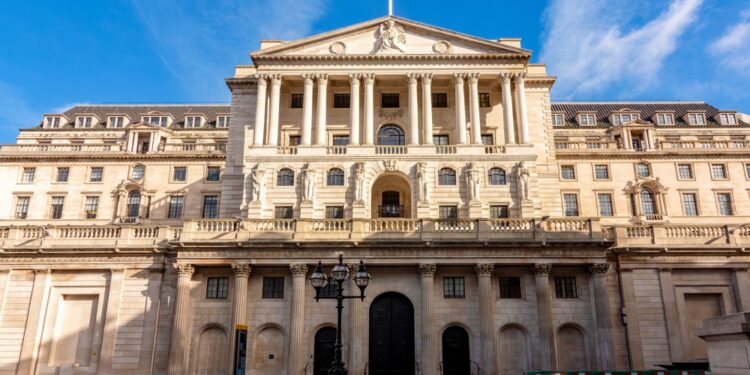
The Bank of England (BoE) held interest rates at 4.75% in its final 2024 meeting yesterday, highlighting the challenge of balancing persistent inflation with slowing economic growth.
Three out of nine members of the Monetary Policy Committee (MPC) voted for a rate cut, giving rise to speculation in the asset management industry about a possible shift toward easing in 2025. However, opinions on the direction of UK rates remain divided.
Guy Stear, head of developed markets strategy at Amundi Investment Institute, suggested that the minority favouring a cut might ultimately be proven right. “The risk is that the six who voted to keep rates unchanged are focusing too much on the recent spate of higher-than-expected inflation figures and not enough on weak growth data. The rise in National Insurance Contributions might translate into lower employment rather than higher prices,” Stear said, forecasting up to five rate cuts in 2025, potentially bringing the base rate to 3.5%.
Others see a more cautious path ahead. The BoE’s decision to keep interest rates on hold highlights the tough balancing act it faces between stubborn inflation and weak economic growth, according to Vivek Paul, UK chief investment strategist at BlackRock. Paul described the challenge as “core services inflation [is] stuck at an elevated 5%,” while the UK economy likely stagnated in the final quarter of 2024. He pointed out that the government’s October budget, aimed at spurring growth, unintentionally pushed up inflation expectations, creating what he called a “tricky trade-off” between managing inflation and supporting the economy.
Looking ahead, Paul expects the BoE to start cutting rates cautiously in 2025, with UK rates settling closer to 3% in the longer term—higher than pre-pandemic levels but below what markets currently predict. “That’s why we remain overweight UK gilts across maturities on both a tactical and strategic horizon.”
Despite challenges like weak productivity growth and a tight labour market, Paul sees opportunities in UK infrastructure, driven by structural shifts such as the transition to a low-carbon economy. “We favour an active investment approach within UK equities,” he added, commenting that the potential US trade tariffs and rising employer costs could further complicate the picture.
UK Budget sees carried interest change welcomed
The BoE’s decision to hold rates steady at its December meeting was expected, reflecting its gradual approach to normalising monetary policy. Jamie Niven, senior fixed income fund manager at Candriam, called the outcome “dovish at the margin,” with three MPC members voting for a 25bps cut, exceeding expectations of just one dissenting voter.
Niven suggested this signals a willingness among some policymakers to accelerate rate cuts, as market pricing may not align with the Bank’s outlook. “The recent data evolution, with activity surprising to the downside and inflation remaining sticky, is pulling monetary policy in both directions,” he explained. He believes the direction of UK rates in 2025 will hinge on whether weaker growth or persistent inflation proves dominant.
The Bank of England’s decision to leave its policy rate unchanged was no surprise, according to Daniele Antonucci, chief investment officer at Quintet Private Bank. Inflation has risen to over 2.5% from 1.7% in September, driven by higher goods and food prices alongside still-elevated services inflation.
“There’s a risk that inflation accelerates somewhat further in the near term,” Antonucci noted, citing resilient wage growth as a potential driver of further inflationary pressure. However, weakening economic growth indicators and moderated Bank expectations could help bring inflation down over the longer term.
This aligns with the MPC’s aim of maintaining a restrictive stance until risks to inflation sustainably returning to the 2% target have dissipated. Antonucci added: “This points to gradual rate reductions, balancing the need to squeeze inflation out of the system while mitigating the degree of economic weakness already apparent in the data.”
HSBC Asset Management ( HSBC AM) observed that markets expect limited further easing from the Bank of England, with just two 25bps cuts priced in for 2025. However, according to the asset manager, the risks lean towards more rate reductions due to signs of weakening labour demand. “The reality is inflation is proving stubborn and persistent,” HSBC AM noted, suggesting that the UK economy will need to adjust to a new environment of higher-for-longer rates, with a terminal rate unlikely to drop much below 4%. For fixed income investors, it highlighted that income will remain the primary driver of returns, adding: “Outside of a recessionary scenario, it’s difficult to see a big crunch lower in yields.”