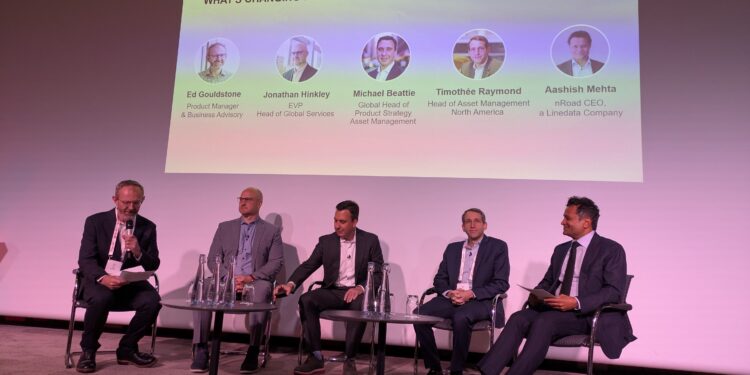
It’s time for asset managers to rethink operating models, workflows and business processes as artificial intelligence (AI) reshapes financial services, panellists said during a discussion at the Linedata Exchange London 2026 conference held on June 10.
In the inaugural session, moderator Ed Gouldstone, product manager & business advisory, Linedata, pointed to the continued rise of passive investing as a source of pressure on active managers, while hedge funds have enjoyed some of their strongest inflows in years. At the same time, questions are emerging over private credit valuations, geopolitical tensions remain high and firms are racing to capture AI opportunities.
Jonathan Hinkley, executive vice president and head of global services at Linedata, said firms are navigating a market characterised by liquidity but also uncertainty. “Some are questioning whether or not we’re starting to get the hangover that everybody’s been expecting,” he said, referring to concerns over market valuations and technology-driven growth.
“One of the key components that comes back to our business is within that type of environment, you need a new operating model,” Hinkley said. Firms need the ability to assess risks in real time and make better decisions as market conditions evolve.
Michael Beattie, global head of product strategy for Linedata Asset Management, said the higher-for-longer interest rate environment is exposing complexities that had previously been masked by years of low rates. As rates remain high, operational processes across asset management organisations are coming under scrutiny.
When it comes to AI, Beattie said the conversation has moved beyond technology itself towards workflow optimisation. He added that the role of middle and back office teams is evolving, with firms becoming less dependent on specialist technical expertise and more focused on subject-matter expertise, workflows and operating models that bring together people, processes and technology.
Timothée Raymond, head of asset management for North America at Linedata, said that AI is not overhyped but that many organisations are underestimating the speed of change. However, he warned that many firms are focusing on the wrong objective. Rather than simply replacing people with AI, organisations should use the technology to redesign inefficient processes. “We need to get to step two very quickly,” Raymond said. “The real transformation to the industry is going to come from that.”
Using KYC processes as an example, Raymond shared that firms should question whether existing workflows remain fit for purpose instead of merely automating them. “How do we use that to rethink the processes?” he said.
Many firms are using AI to make existing processes cheaper and faster rather than questioning whether those processes should exist in their current form at all, said Raymond. Technology presents an opportunity to redesign operating models from the ground up rather than simply replacing human tasks with automated ones, he added.
Aashish Mehta, CEO of Linedata-owned financial technology company nRoad, said the industry is moving beyond the initial rush into AI towards a mature phase focused on outcomes and measurable returns. “Firms are focusing on the ROI metric, including how AI can generate alpha, improve productivity and preserve institutional expertise,” said Mehta.
A shift from passive AI tools towards more proactive AI agents is also underway, highlighted Mehta, as firms focus on practical use cases and business outcomes rather than experimentation.
At the same time, AI models remain inherently probabilistic, making auditability and oversight critical. “Any time you make an AI-based decision, it needs to be completely auditable and traceable,” said Mehta, adding that regulators ( such as the EU AI Act’s guidelines on AI decision-making) would demand more transparency as adoption grows.
The panel also highlighted the importance of data quality and technology architecture. Beattie said COOs and CTOs increasingly want “choice” and open architectures rather than relying on a single software provider. Most asset managers operate complex technology stacks rather than a single end-to-end platform, making interoperability and system integration increasingly important as firms scale AI initiatives. Success will depend on clean data, strong APIs and seamless integration across systems, added Beattie.
Raymond said the key challenge for firms will be understanding “what makes you different” in a world where technology increasingly becomes accessible to everyone.
Debates around regulation, AI adoption and investor expectations will intensify, forcing firms to balance innovation with risk management and oversight, predicted Hinkley. “We’re going to be reconciling between two different societies, one that’s going to be pro-crypto or pro-AI and one that’s going to be pulling back,” he concluded.