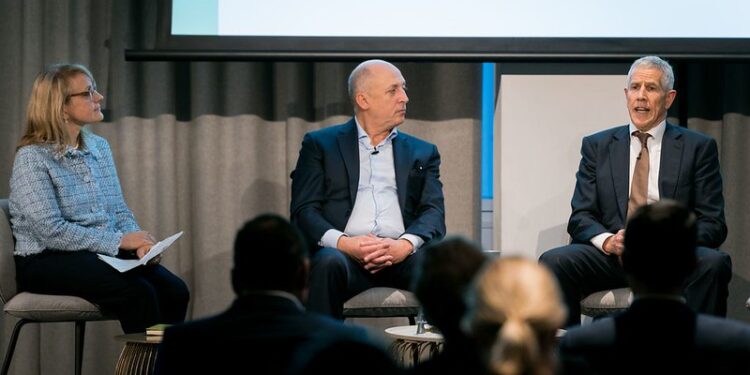
Hendrik Du Toit, the chief executive of Ninety One, said he founded the company in South Africa with $1 million of capital and since then the firm had paid $3 billion to shareholders. But an asset manager is unlikely to replicate this success in the decades to come, he said, because the world of 30% margins that was once typical of the asset management industry had passed.
Joining Du Toit (above, right) in a discussion at a recent event, Sandro Pierri, the CEO of BNP Paribas Asset Management, described margin compression as “very significant” in the years ahead compared to the “super nice environment” of the past 20 years. The next ten years would be very different.
Pierri said disruption in geopolitics pointed to lower growth and there would be a degree of structural inflation, too. The asset management industry would see “4-5% growth if we are lucky”, partly due to a return of cost inflation. The industry is “condemned” to become more efficient.
Du Toit agreed and added that “extreme events” would put structural pressure on fixed income. He highlighted how the industry had been punished by “shock interest rate increases”.
“I don’t think we’ve realised the scale of it,” he said, adding: “Private markets will feel it for years to come.” There is an element of “denial” in the illiquid, private markets sector and businesses would have to refinance, he said.
“Technology growth path”
The two CEOs were speaking in a discussion hosted by Micaela Forelli, the Luxembourg-based CEO of M&G Europe last week. The event took place as part of the annual London conference of the Luxembourg funds industry association, Alfi.
Despite his warning of denial surrounding private assets, Du Toit said the asset management industry needed to invest more in this area in order to provide more illiquid solutions to clients.
Numerous industry surveys have shown that asset owners have greater demand for illiquid assets, such as private equity and private debt. For asset managers, a headwind here, said Du Toit, is that managing these private markets investments requires more people and entails greater operational costs. Artificial intelligence (AI) may help the industry but firms should have invested more in technology over the past 30 years, the Ninety One CEO said.
Describing technology as offering a “growth path”, Pierri agreed that the industry had not invested enough in both technology and data, which led to a significant technology gap in asset management.
Pierri said the cost of doing business is growing exponentially. Partly, this is down to the amount of regulation. He said regulation was needed and that he did not stand against it, but he expects regulation to increase.
He also said that industry leadership in the next ten years would need to be more process-driven and that leaders would need to be more “business rounded” people rather than necessarily from a background of portfolio management. Pierri started out in the industry as a US equity manager and his career also encompasses the leading of Pioneer Investments before its sale to Amundi.
“Pick their places”
The two CEOs spoke about industry consolidation. Most important for success is scale rather than size, said Pierri. People confused size with scale, he said. A symptom of this was for firms to expand geographically thinking they could “put a flag in a country and see what pops out in a few years”. This is no longer possible, he said. Instead, firms should strive for organic consolidation, by which he means winning market share from each other, a process much cheaper than M&A.
Du Toit agreed strongly, saying: “M&A is just the tip of the iceberg of consolidation.” Firms would likely handle consolidation and the building of scale by “going from six things to three things”.
He argued that clients were much more conscious about costs now and that asset managers would have to “pick their spaces” and deliver a best-in-class offering.
“On the buyside, the safety net will be removed from the people who can’t understand how much more they will have to push themselves to deliver on the client promise,” said Du Toit.
Giving a further nod towards technology, Du Toit described asset managers as the “darlings of financial markets” until the Covid pandemic, largely avoiding regulatory action and delivering on transparency. But now the industry must ‘lift its game’ and this includes by executing business digitally because that is what clients want. He also said that he hoped the industry would be able to use the power of digitisation, AI and “whatever comes after that” to support good capital allocation.
“Trial and error”
The next phase of industry evolution will include some “trial and error”, said Pierri, but the vast availability of data – which he said existed particularly in fixed income – could be a supportive driver.
Forelli asked if ‘best-in-class’ extended to sustainability products and strategies.
Pierri said sustainability was not a “marketing gimmick” for BNP Paribas AM and that the firm had invested sustainably before it was fashionable.
“We didn’t wait for the SFDR [to invest sustainably]. When the SFDR came into place, we found we had 90% of the assets already in place.”
SFDR – the Sustainable Finance Disclosure Regulation – denotes the EU framework for marketing sustainable investments.
Pierri said that sustainable investments had demonstrated a market cycle in the past few years since the “excitement” about ESG that followed the Covid pandemic, and that disappointing returns seen in some cases meant people now questioned sustainable investing and wider ESG as a return driver.
However, Pierri said there had never been a guarantee that ESG would outperform every single quarter or year, and he believes that investors should have ESG as part of their philosophy if they are to deploy ESG strategies correctly. Asking if ESG performance would be superior to non-ESG performance is a question that – like the debate around value versus growth – may not be definitively answered.
He said it was important to have an appreciation for volatility in the sector. Nevertheless, the four-year time horizon had proven positive, he said.
We have a moment to move here from casino capitalism to a truly relevant industry
Asset managers must also “demystify and de-ideologise” the ESG debate, said Pierri.
Du Toit suggested that in the “red states” of the US, a view prevailed that a “sustainability police state” existed in the western media and that ‘greenhushing’ – the practice of a company to not speak about ESG issues, even if it has an ESG programme – should not be viewed as a “sin” and that it was possible to discuss sustainability in these American states in a manner that was respected by investors based there. It’s up to asset managers to do this correctly.
“World of retribution”
Du Toit warned that a risk within the ESG sector would be when there is a “world of retribution”, perhaps some five years from now when the world is not cooler.
Pierri said the industry would still make mistakes with sustainable investing. Du Toit agreed and said regulators must understand this else asset managers would not engage with the topic and that capital needed for the transition would not flow to where it is needed. Pierri said there is enough capital but said it is not yet mobilised properly and – adding that the capital is “in the hands of people that have less interest in a transition” – he said it was important to create the right institutional framework.
Du Toit added: “We have a moment to move here from casino capitalism to a truly relevant industry.” $2-4 trillion a year could “fundamentally change the world”, he said, but people are so confused by the language around ESG that they “go to money-market funds” instead.
“A certain US player”
The two CEOs also spoke about European markets and the competitive state of the European asset management industry after Forelli pointed to a report from the European Fund and Asset Management Association that had shown the difference in foreign investing between US and European investors. Europeans invest more globally than investors do in the US, where the home bias is more prominent.
Pierri pointed out that European markets had underperformed US markets historically and he highlighted the importance of the EU Capital Markets Union for making EU markets more attractive. He also lamented the focus on costs among investors, suggesting this had incentivised passive investments and that it would be difficult to finance the carbon transition without active management.
 In terms of competition with US managers in Europe (Forelli had referred to US managers potentially “eating our lunch”) Du Toit said it was important that there was a political will to compete and that Europe needed a dynamic savings pool prepared to take risk.
He also said that UK politicians “gave a certain index business to a US company”. In 2009, Britain’s Barclays Global Investors was sold to America’s BlackRock, a move that was transformational in BlackRock’s history.
Cheaper than a name
Elsewhere in the conversation Pierri described BNP Paribas AM’s business as being 20% in Asia, 10% in the Americas, with the balance in Europe. However, he emphasised that the firm’s business was 80% external and so BNP Paribas AM was not reliant on distribution through its wider banking group parent.
And Du Toit offered an idea for how asset managers could keep their costs down. Describing how Ninety One – formerly known as Investec Asset Management – got its name following the 2020 demerger from Investec Group, he said: “It’s much cheaper to register a number in a country than a name!”