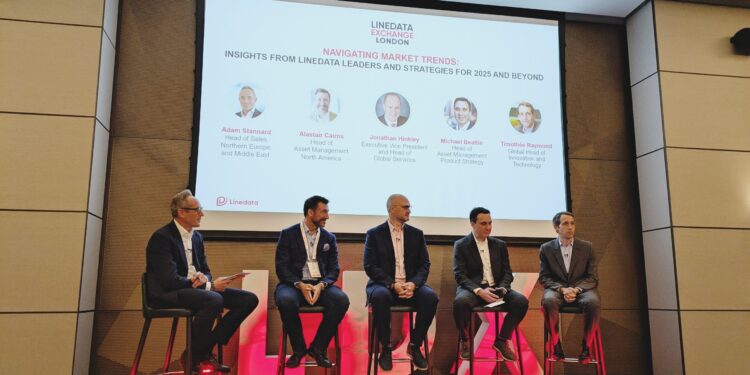
How are regulatory pressures, volatile markets, private capital expansion and technological innovation reshaping the operational and cultural priorities of asset managers in 2025? That was the topic explored in the inaugural panel of the Linedata Exchange Northern Europe 2025 held in London yesterday.
The leadership panel of asset management tech provider Linedata was moderated by Adam Stannard, head of sales for Northern Europe and the Middle East. The discussion began with Michael Beattie, head of asset management product strategy, highlighting a shift in asset class allocation over the last decade. “If I look in the asset management space, you see that the asset class mix in investment has changed,” he said. The past five to ten years have seen a move beyond traditional equities and fixed income into private markets, driven by the search for new sources of alpha. Yet more recently, macroeconomic changes—particularly the emergence of inverted yield curves in the U.S. and Europe—have led to an increased emphasis on short-duration products. “Most asset managers have had to overallocate to cash, to time deposits, or money market securities. It’s a tactical shift, but a very real one,” Beattie added.
He went on to note that asset managers are now demanding fully integrated, modular systems that can be deployed quickly. “It shouldn’t take three years to implement software,” he remarked. “The expectation now is a solution that handles order creation, analytics, execution—end-to-end—without delay.” This emphasis on seamless workflows marked a recurring theme throughout the panel.
Alastair Cairns, head of asset management North America, pointed to the accelerating momentum of the retail and wealth channel. “That’s where the new asset growth is coming from,” he said. “It’s not a new trend, but in the last year or two, it’s taken off.” This has forced asset managers to figure out how to bring private market offerings to a retail audience—a challenge requiring new product structures and operational frameworks. “Now you have to support 40,000 accounts, not 10 big institutions. That’s a different game.” Cairns described a rising interest in vehicles like interval funds, which allow for private asset exposure in a regulated retail format. The challenge now is scale—supporting high customisation without more costs.
Final chance to enter Funds Europe Awards 2025
Echoing this, Jonathan Hinkley, executive vice president and head of global services, said many asset managers are targeting a doubling of AUM over the next five years—without proportional cost increases. “The pressure is real. They’re asking: how do I scale efficiently? How do I do this without doubling headcount?” Hinkley emphasised that automation and smart process design are key. “AI is definitely one of the components,” he noted. “It’s enabling processes we simply couldn’t do before.”
Timothée Raymond, global head of innovation and technology, emphasised that the convergence of private markets with retail delivery models is not just operational—it’s deeply cultural. “Shops that were either pure wealth or pure institutional now have to do both,” he said. “It changes how you talk to investors, how you staff your teams, and how you build your systems.” Raymond pointed to the adoption of automation in compliance-heavy processes as a sign of how quickly expectations have evolved. “You don’t have to read the documents anymore,” he said. “You don’t need to rely entirely on humans—and that was unthinkable until very recently.”
Beattie and Cairns discussed the growing importance of partnerships and APIs in the front office. From portfolio decision support to trade automation, asset managers are turning to best-of-breed solutions that integrate through modern architectures. “We’ve moved from thinking about single-security automation to multi-asset, liquidity-informed trade routing,” Beattie said. “You’ll see a desk now trading equities, fixed income, and OTC derivatives together, using external data to drive execution logic.” Cairns added that this shift requires interoperable systems. “We can’t rely on vertically integrated, closed stacks anymore. Data has to move—freely, reliably, and securely.”
The panel also addressed one of the industry’s most pressing challenges: preparing for real-world deployment of AI tools. Hinkley warned that while experimentation has been prolific, foundational issues remain. “We’ve exploded our data sets over the last five years. But the tagging? The consistency? The governance? That’s lagging.” Without addressing this, firms risk underperformance from even the most advanced tools. “Make sure your data architecture is solid before trying to build on it,” he said.
Raymond cautioned against misapplying AI out of enthusiasm. “We’re trying to apply AI to problems that don’t even need it,” he said. “Balance and governance are key.” Beattie agreed, stressing that any AI implementation must be digestible and auditable. “How do I track decisions? How do I explain them to a regulator? That’s the question every client is asking.” Compliance, once a purely rules-based function, is becoming increasingly predictive and adaptive, enabled by AI models that learn from live data. “It’s a complete change in how we think about risk,” Raymond said.
Closing the session, Hinkley reiterated the broader impact of automation. “Efficiency is the primary driver, but it also expands your coverage. Your analysts and portfolio managers can see more of the market, make faster decisions, and do it all with greater transparency.” That, he said, is where the real unlock lies.