
Fund managers are staying cautiously hopeful about markets, even though global growth outlook is weakening and there’s uncertainty over what the US Federal Reserve will do next, according to asset manager Quilter’s latest Investor Trends Survey.
The survey, which polled 21 fund management institutions, found respondents ranked their six to nine month risk appetite at an average of 5.4 on a scale from one (very bearish) to 10 (very bullish). The results suggest managers are reluctant to pull back risk, shared Quilter.
Markets have performed strongly since Donald Trump first announced the introduction of heavy tariffs on 2nd April, cited the researchers, with the MSCI USA index rising by 24.5% since it hit its trough soon after, and up 2.2% since the start of 2025.
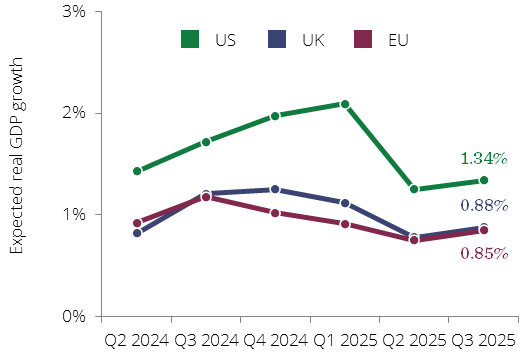 At the start of the year, investors were betting on US economic growth topping 2% in 2025. Now those forecasts have been cut back to 1.3% for this year and 1.6% for 2026. According to the researchers, the risk of a recession has eased, but the world’s largest economy is still struggling to generate stronger growth.
The outlook for the UK and Europe has also weakened, less dramatically though, with GDP projections falling to 0.88% and 0.85% respectively for 2025.
Despite the situation, fund managers anticipate only limited rate cuts. Respondents expect US interest rates to remain at around 4% at the end of 2025 and decline to 3% in 2026, suggesting less scope for more aggressive policy loosening unless unemployment rises. With inflation forecasts revised higher to 3% for end-2025, up from 2.45% a year ago, rate-setters may find their options constrained.
Investors expect Jerome Powell to remain as Fed chair until his term ends in May 2026, despite speculation that Donald Trump could attempt to remove him early to force faster rate cuts. Just 12% of respondents anticipate such an outcome.
Institutions back growth with AI, innovation spend: Lloyds Bank survey
Lindsay James, investment strategist at Quilter, commented: “News of slowing GDP growth, sticky inflation, tariffs, and interest rates getting stuck would suggest now is the time to be bearish. Indeed, after a strong rally following the ′Liberation Day’ induced falls in April, market participants would be forgiven for wanting to take a breather and remove risk from the table. However, this appears to be far from reality. In fact, fund managers remain ‘cautiously bullish’ on the prospects for future market returns.
Valuations remain toppy in some areas, so for how long such sentiment can continue remains to be seen, but if corporate earnings continue to resist the weak economic backdrop, markets may just have a little higher to go from here. A lot of this hinges on what the Fed does with interest rates and how businesses in America deal with increased costs from tariffs.
The market expects Jerome Powell to stay as Federal Reserve Chair, and while the US economy has not quite rolled over, it is clear it is being stressed at the seams. A sustained period of rate cuts, therefore, looks unlikely, while it will probably be the US consumer that bears the brunt of the tariffs. As such, there appear to be risks lurking around every corner for investors, but confidence clearly has not been shattered. Consequently, it will be fascinating to track the sentiments of these fund groups going forward.”