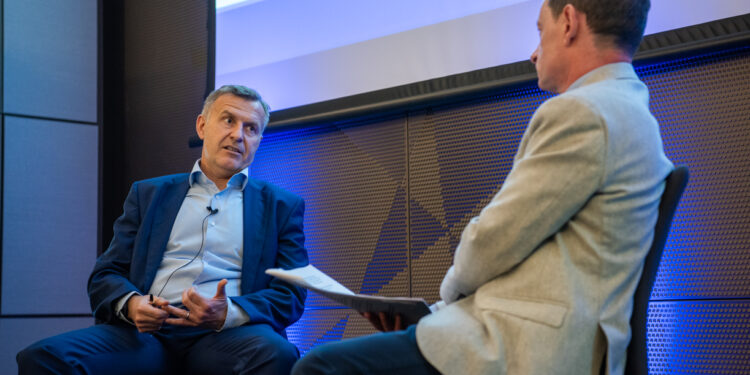
Fresh from completing the London Marathon, Mike Tumilty, global COO of Aegon Asset Management, opened the FundsTech 2025 conference in London today to share insights into the operational challenges and strategic priorities facing asset managers today.
Tumilty discussed how the sector’s relentless pressure to reduce costs has become a marathon in itself. “It’s not about working harder, but working smarter,” he told a packed room of delegates, comparing the evolution of asset management firms to the training regimens of elite athletes — needing speed, endurance, and smart decision-making to survive.
The industry’s margin pressures, he explained, have only intensified since the global financial crisis, leading firms to seek scale through major mergers and acquisitions. Tumilty cited Aegon’s own transformation, consolidating three disparate businesses into a unified €280 billion global asset manager, as a prime example of the new operating models required to compete.
Central to Aegon’s operational overhaul has been the adoption of BlackRock’s Aladdin system. Tumilty provided a candid account of the four-year journey to consolidate onto a single investment management platform — describing it as both essential and extremely demanding. “We always wear rose-tinted spectacles with big change projects,” he said, warning of the dangers of underestimating timelines and costs.
Despite the significant investment, Tumilty emphasized that the Aladdin project brought major efficiencies, especially in data management, risk controls, and compliance processes. However, he acknowledged that measuring the true value versus cost remains a challenge, particularly given the evolving needs around private markets and alternative assets.
The discussion also turned to the evolving roles of COOs and CTOs in the sector. Tumilty suggested that technological expertise is now a non-negotiable part of leadership, predicting that the distinction between operational and technology executives will continue to blur in the coming years. “The CEO must understand technology, and the CTO must understand the business,” he asserted.
Asked about the role of fintech startups, Tumilty encouraged dialogue between large institutions and smaller innovators, stressing the importance of collaboration to foster new ideas — albeit tempered by the realities of scale and integration challenges for large, regulated firms.
In closing, Tumilty reflected on the heavy responsibility faced by asset managers, particularly under increasing regulatory scrutiny. With client assets often representing retirement savings and long-term investments, the stakes are higher than ever. His parting message? Strategic transformation requires both patience and resilience — just like running a marathon.