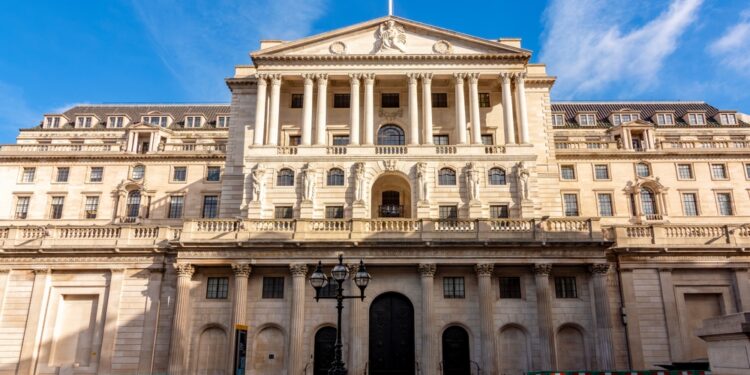
The Bank of England (BoE) cut interest rates by 25 basis points to 4.5% yesterday, marking the lowest level since June 2023. The decision came against a backdrop of downgraded UK economic growth forecasts, with the bank now predicting 0.75% GDP growth in 2025, down from an earlier estimate of 1.5%.
Despite the expected rate cut, the division within the monetary policy committee (MPC) surprised markets. Two members, including Catherine Mann, unexpectedly voted for a more aggressive 50bps cut, signalling heightened concerns about weak economic growth. Jamie Niven, senior fixed income fund manager at Candriam, noted that the shift in Mann’s stance—previously one of the most hawkish members—suggests that even firm inflation watchers now see a need for greater monetary easing. “This mixed picture is an awkward place for the Bank to be in,” Niven said, pointing out that the inflation forecast remains above target even in 2027, complicating the BoE’s policy path.
Market reaction was swift, with the FTSE 100 hitting a new record high ahead of the announcement. Garry White, chief investment commentator at Charles Stanley, attributed this to the weaker pound, which benefits UK blue-chip companies that generate the majority of their earnings abroad. “The continuing divergence of major central bank policy means we could see more records ahead,” he said, explaining that while the BoE and ECB appear dovish, the US Federal Reserve is more hawkish, potentially strengthening the US dollar at the expense of sterling. He also suggested that Donald Trump’s potential return to the White House could push the dollar higher, given his policies on tariffs, tax cuts, and immigration, which may add to inflationary pressures.
Katharine Neiss, chief European economist at PGIM Fixed Income, noted that UK economic activity has been deteriorating since early last year, with GDP growth stalling at zero in Q3 2023 and expected to remain close to zero in Q4. She emphasised that, despite the BoE’s rate cut, UK rates at 4.5% remain significantly higher than European peers, which could make UK assets more vulnerable to shifts in market sentiment. “Given those vulnerabilities, aggressive rate cuts in the near future could prove to be a false economy if they trigger capital outflows and a further leg up in longer-term yields,” she warned. While the BoE is expected to continue on a cautious cutting path, Neiss believes that, unlike in the US, there are more rate cuts ahead for the UK than behind it.
Market reacts to Bank of England rate cut
In fixed income markets, reactions were mixed. Neil Mehta, Portfolio Manager at RBC BlueBay Asset Management, warned that while lower rates may support economic activity, they risk fuelling inflationary persistence, especially with core inflation above 3% and wage growth exceeding 5%. “We are far from the 2% inflation target, and easing policy too soon could entrench higher prices,” he cautioned, adding that energy-related price shocks often have a longer tail via wage and service inflation. Given these risks, long-end gilt yields may not rally significantly, as markets remain skeptical about how quickly inflation will fall.
Some prefer short-dated gilts instead. “They’re attractively valued and should benefit from rate cuts as well as slower growth, partially protecting portfolios if the economy was to underperform expectations,” said Daniele Antonucci, chief investment officer of Quintet Private Bank (the parent of Brown Shipley). Antonucci’s bank remains overweight US equities but has lowered European exposure to neutral due to tariff risks, while maintaining an insurance instrument that benefits from European equity declines. “We also have a neutral exposure to UK equities, in line with our long-term asset allocation,” he added.
Chancellor Rachel Reeves welcomed the BoE’s decision but acknowledged that the UK’s growth rate remains disappointing. Some economists believe fiscal policy could play a key role in shaping the economic outlook. Luke Bartholomew, deputy chief economist at Abrdn, suggested that the BoE may not ramp up rate cuts too quickly until it sees how the economy absorbs the upcoming National Insurance increase. “The Bank’s signals today suggest there is scope for several more rate cuts this year,” he said, adding that rates could fall below 3% over the next two years if weak growth persists.
Not all analysts are convinced that the BoE is moving in the right direction. Zara Nokes, global market analyst at J.P. Morgan Asset Management, argued that the Bank may be acting too soon, given that inflation expectations remain elevated. “While economic activity is slowing, inflation pressures are not,” she said, citing higher energy prices, strong wage growth, and businesses passing on costs following October’s tax hike. She also warned that rate cuts might be popular in the short term, but if inflation is not controlled now, there will be a higher price to pay further down the line.
Looking ahead, the BoE has signalled that further rate cuts are likely, but the pace and scale remain uncertain. While some MPC members push for faster easing, others remain concerned about sticky inflation and potential global economic turbulence. Tim Graf, head of EMEA macro strategy at State Street Global Markets, believes the Bank will continue easing gradually rather than pursuing aggressive cuts. “The stated preference for ‘gradual and careful’ adjustments suggests policymakers will take a measured approach,” he noted.