The M&G Annual Investment Forum 2025, held at The Londoner on February 4, focused on navigating volatile markets with long-term resilience, active management, and adaptable strategies.
In his opening address, Alex Matcham, head of UK wholesale sales at asset management firm M&G Investments, set the tone, saying: “It’s moments like this amid uncertain and volatile markets when the human element of investing is crucial.”
Equities remained dominant in 2024, marking two consecutive years as the best-performing asset class, but Fabio Fedeli, CIO equities, multi-asset and sustainability, M&G Investments, warned against assuming that strong macro growth always aligns with stock performance. She emphasised that low GDP and high equity returns often coexist, noting that in a five-year period, 40% of the best return days followed negative ones. “Emotional resilience is key,” she said, urging investors to stay invested through cycles rather than react to short-term volatility.
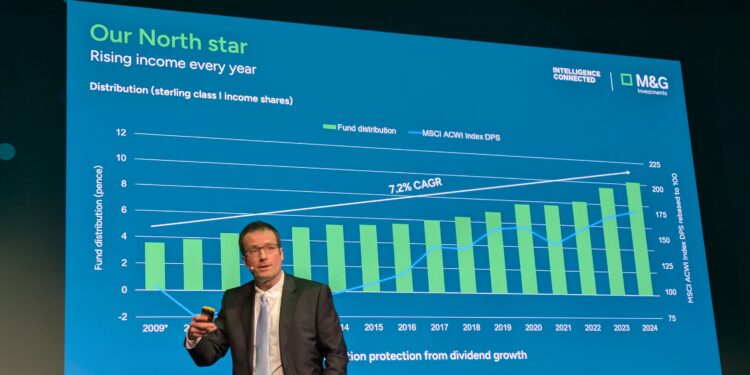
Stuart Rhodes, director of global equities at M&G Investments echoed this sentiment in his session “Essentials for the long haul” on long-term investing, stressing that “time in the market matters more than timing the market”. Managing the M&G Global Dividend Fund for 17 years, he shared that for fund managers managing a fund for an extensive period, success requires balancing discipline with adaptability. “Don’t lose sight of your north star,” he said. Next, he went on to highlight the power of compounding dividends and the importance of regenerating portfolios while maintaining long-term vision.
Rhodes also addressed a lesser-talked-about topic in the world of fund management – the intense pressures fund managers face. This could stem from the market, the press, clients, as well as their own expectations. “Fund management is a highly competitive field with an instant feedback loop. It’s the best job when things are going well, but a real test when they’re not,” Rhodes shared. Keeping investors engaged during market downturns is one of the toughest challenges, as managers must navigate not just tough questions but also the emotional burden of maintaining client confidence in difficult times. His advice: “Hug your north star—discipline and flexibility are key to running the same fund successfully for a long time.”
Addressing the dominance of the Magnificent 7 stocks— Tesla, Meta, Microsoft, Apple, Amazon, Alphabet and Nvidia— which account for 35% of the S&P 500 index, Rhodes also dismissed comparisons to the “dot-com bubble”, arguing that while valuations are debatable, these companies are delivering strong numbers. Flexibility also extends to dividend investing, where Rhodes highlighted the importance of distinguishing between established dividend players (Apple, Microsoft), dividend initiators (Meta, Alphabet), and non-dividend payers (Amazon, Tesla). Investors should also seek correlations beyond traditional classifications, such as Broadcom, ASML, and TSMC, which offer dividend opportunities similar to the Magnificent 7 stocks.
CEO Joseph Pinto to give keynote interview at FundsTech Forum
Fixed income took centre stage in a discussion led by Andrew Chorlton, CIO of fixed income at M&G Investments, alongside Richard Woolnough, fund manager, M&G Investments; Eva Sun-Wai, fund manager, M&G Investments and James King, head of structured credit, M&G Investments. Bonds are more than just a diversifier, noting their resilience in shifting economic conditions, according to the panellists. According to the asset management firm’s outlook, structured credit is an integral source of real-economy financing, offering diverse investment opportunities across both public and private markets. Spanning various capital structures and borrower types, it allows investors to target different risk/reward profiles.
Structured credit, as an asset class, has been turbocharged by supply and demand dynamics, with core growth areas emerging in consumer and corporate lending, particularly in private markets. “We have identified unique exposure opportunities in real-economy credit assets,” M&G Investments stated. Investors can access this sector through asset-backed securities, collateralised loan obligations, synthetic risk transfers, speciality finance, and other asset-backed formats.
Global corporate bonds, second only to government bonds in size and liquidity, offer trillions in investment opportunities. In the session “Get active to capture the potential of global corporate bonds”, Ben Lord, fund manager at M&G, emphasised that an active, well-researched approach enhances their potential, highlighting relative value trading and the benefits of expert credit analysis.
While investment-grade corporate bond spreads remain tight, he pointed to diversification benefits across rates and spreads. “There is a buffer in all-in yields, but little room for error in spreads,” he warned, advocating for a flexible, regionally diversified strategy to capture opportunities amid return dispersion.
M&G’s defensive positioning for 2024 was another key theme, with covered bonds and Guaranteed Investment Contracts (GICs) playing central roles. Covered bonds, backed by high-quality assets, offer enhanced investor protection, with “no defaults recorded in history”, shared Lord. On the other hand, GICs, issued by insurance companies, provide capital preservation and predictable returns, reinforcing their appeal in uncertain markets.
Going global enhances this further, providing greater diversification, lower volatility, and broader market opportunities. “The sterling investment-grade universe is just £0.47 trillion compared to the $11.1 trillion global market,” Lord noted, underscoring the benefits of a wider investment scope. Active management, Lord pointed out, helps identify undervalued bonds, avoid weak issuers, and exploit market inefficiencies. Additionally, it enables strong credit analysis, strategic risk positioning, and participation in primary markets while offering flexibility in trading, timing, and sector rotation.
Lord also shared that he favours the front end of fixed income while focusing on risk reduction. Investment-grade corporate bonds offer natural diversification, with rate and spread components acting as separate return drivers throughout economic cycles.