Two major considerations for investors with their passive allocations are, first, which markets to approach passively, and second, what products to employ for market access. Our expert ETF panel discusses this and other topics including ESG investing and crypto exposure.
Participants
- Monika Calay, head of the UK manager research team, Morningstar
- Elizabeth Carey, adviser, Torfaen Pension Fund
- Weichen Ding, senior public markets manager researcher, bfinance
- Gilles Dubos, senior expert, ETFs, Caceis
- Louis Hutchings, fund-of-funds portfolio manager, Nedgroup Investments
- Tony O’Brien, chief commercial officer for Ireland, US Bank
Synthetic ETFs exposed to major US equity indices have attracted attention in the past two years owing to potentially stronger returns compared to physically backed ETFs with the same benchmarks. This is because synthetic ETFs backed by total return swaps rather than physical shares can pay lower withholding tax on dividends paid by US companies to non-US persons.
The shift in the environmental factors that could favour synthetic exposure to US stocks has resurfaced a debate that’s not been heard for a decade: the virtues of ETF construction.
Monika Calay, head of the UK manager research team at Morningstar, said BlackRock sparked greater sympathy for synthetics after a decade during which the ETF giant espoused physical ETF replication. Two years ago, the firm launched a synthetic S&P 500 ETF for European investors.
“This might lead other issuers to strategically offer synthetic products, but much will depend on whether there’s a tax advantage.”
Calay was speaking at a Funds Europe ETF roundtable held recently and which discussed ETF construction, the rise of active ETFs, and the prospect for crypto adoption, among other topics.
Easier than buying shares
Tony O’Brien, chief commercial officer for Ireland at fund administrator US Bank, believes there is a resurgence of interest in synthetic ETFs following BlackRock’s move.
“Synthetic exposure in a passive product is easier than buying all the underlying stocks and gets you close to a 100% accurate tracking of the reference index,” he said.
He added that synthetic replication also unlocks another potential revenue source for the issuer. The counterparty – who promises to pay the return on the index – secures this with a collateralised basket of securities, which the ETF issuer can lend out for additional revenue.
Although physical ETFs offer a similar revenue opportunity from securities lending, Calay said securities lending on the S&P 500 was limited as demand for borrowing large-cap US equities was low. Nevertheless, she felt demand for synthetic replication of ETFs would be limited.
“People still need to do their homework with synthetic ETFs, including understanding risks like counterparty risk. Unless there’s a clear advantage – such as with US equity dividends where there’s a tax benefit – I don’t anticipate a widespread resurgence in their use.”
Synthetics used in first launches
Gilles Dubos, senior expert, ETFs, at custody bank Caceis, acknowledged this complexity but also said that he saw synthetic ETFs being popular among first-time ETF issuers.
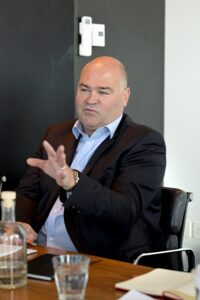
“I have seen asset managers using synthetics for their first ETF launch, but with the intention of converting to a physical product at a later date if it is successful”
Gilles Dubos, Caceis
“Many investors are put off by the perceived complexity. However, I have seen asset managers using synthetics for their first ETF launch, but with the intention of converting to a physical product at a later date if it is successful.”
The complexity around synthetic ETFs is related to the swaps involved. Not only are the instruments comparatively esoteric in relation to physical equites, some investors still have bad memories of derivatives turmoil following the collapse of Lehman Brothers, where counterparty risk exponentially increased.
However, Weichen Ding, a senior public markets manager researcher at investment consultancy bfinance, said: “The usage of derivatives may have deterred people from synthetic exposures because of the counterparty risk, which some investors may be less familiar with, but the collateral involved in creating synthetics is, in fact, very safe.”
He said clients currently tend to prefer physical replication and that although synthetics could gain higher returns owing to lower costs in comparison with physical ETFs, physical ETFs can engineer lower costs by optimising their portfolios. This potentially makes them competitive with synthetics ETFs.
An example of optimisation is where a manager buys fewer stocks than the index, perhaps focusing on the stocks in the index that are bigger drivers of returns.
On the point of risk, O’Brien pointed out that risk is mitigated by a set of standards set by the International Swaps and Derivative Association. He also pointed out that counterparty risk exists in physical ETFs if those ETFs engage in securities lending.
Elizabeth Carey, a pension fund adviser who works with local authority pension schemes Torfaen in Wales and Bedfordshire in England, said it would be difficult for many pension fund trustees – who are not fulltime investment professionals – to understand derivatives risk.
However, she also noted that she had seen examples of asset managers using synthetic construction for certain sector exposure or for thematic investments within pooled funds that were well understood by pension clients and their trustees.
Active v passive discussions
The Funds Europe ETF panel also spoke about how passive investing fits into wider portfolios alongside active investments – and, again, the topic of US large-cap equities is relevant here.
Louis Hutchings, a fund-of-funds portfolio manager within Nedgroup Investments, a wealth and investment manager, said: “Our asset class strategy group puts a special focus on not only the asset classes of interest to us at any point in time, but also how to best access these asset classes – and this is where the active and passive discussions come in.
“We view the US large-cap market as being a place where it is difficult for active managers to add value, unlike in small caps where there are opportunities.
“Emerging markets form an important part of the portfolio, too, and costs are clearly a factor to be mindful of here. Emerging markets are cheaper to access via ETFs, but equally this is a market with real alpha potential, where an active manager can more than make up for the higher costs. Ultimately, in a market where there is no real alpha potential, lower costs are an advantage and it makes sense to allocate towards the pure beta play at a lower cost, but equally there are areas where being active is the more logical approach.”
Calay said Morningstar research showed that it was “very, very difficult” for active managers to add value from US large-cap equities.
“But there are other categories where they have higher success rates – for example, in UK small caps and in fixed income where, over the past few years, passive bond funds have had higher duration profiles than active bond funds.”
Duration has been a key ingredient for bond returns in recent years characterised by higher, inflation busting interest rates.
In emerging markets, Calay said some active managers had added value by lowering the weight of China in portfolios compared to major reference indices.
Beyond this, she said passive products were still used as core building blocks in portfolios and were also used to add diversification or to simply lower the costs of portfolio management.
Ding pointed out there is a well-known difficulty with successful active manager selection. Sometimes there is a serial disappointment that ultimate drives investors into passive investing.
“Theoretically there are certain asset classes that give you more alpha potential, but it’s also a question of whether the fund selection team has the resources and the capability to select the right manager for them.

“We’ve seen investors become disappointed with their active manager, replace them, and get disappointed again. Then they switch into passive”
Weichen Ding, bfinance
“We’ve seen investors become disappointed with their active manager, replace them, and get disappointed again. Then they switch into passive.”
He sees examples, too, of where investors set a cap on overall costs for a particular strategy. Within cost boundaries, investors might find they can selectively insert an active manager to an asset class to add alpha but in other asset classes they will consider a low-cost passive vehicle.
Tony O’Brien at US Bank said the core-satellite approach – where passive is likely to form the core of a portfolio – was seen by ETF issuers to be a great potential for ETF products some 20 years ago when ETFs were relatively new in Europe. But it still took 20 years for institutions to start using ETFs as a portfolio allocation tool.
“The retailisation of ETFs that was seen in the US did not happen here in Europe. Instead, the ETF became very popular among wealth managers, who started putting their clients into these products. They found ETFs to be more efficient and transparent. The idea that you can get a valuation for the product intraday was incredibly attractive to them.”
Elizabeth Carey said some local government pension funds obtained a large share of their equity exposure from passive investments, the balance being active.
But she pointed out that most pension funds in the UK will not use ETFs for this and instead use life insurance fund structures because they are more tax effective. Also, as long-term holders, they don’t need to trade in and out of markets very often.
“However, some active managers employed by pension funds do use ETFs to get an exposure to a sector such as small caps. ETFs are commonly used as a beta proxy and for adding tactical exposure or for diversification.”
Carey’s point highlights how the phenomenal success of ETFs is more muted among pension fund investors, at least in the UK, where unlisted fund structures are preferred for passive exposure to equities.
ESG version 2
However, there is another way in which pension funds might work with passive investments, and that is to achieve sustainability investing goals.
Carey described this “ESG version 2”.
“ESG version 2 goes beyond low carbon and exclusions and more deeply into working with big data to create more systematic strategies that chase alpha but at a lower cost than pure active. Yet we still view this as an active asset allocation. To an extent, I see this as a merging of ESG v2 with Passive v2.”
ESG v2 is more forward-looking – for example, where a fund manager will track a stock’s progress towards net zero and use engagement to ensure that transition.
“This can be achieved on a more systematic basis and with ‘index-plus’ products. It is also happening in the ETF world – the same strategies, but a different wrapper. To be forward looking is to understand that although copper wire producers have a very high energy footprint, they are also vital for electrification and a lower-carbon future,” said Carey.
Briefly, the panel considered the politicisation of ESG in the US. Elizabeth Carey said: “Although ESG has become political, there are also legal and risk mitigation requirements that have the effect of placing some requirements on investors who would not consider themselves to be ESG investors. An obvious example is pollution, where failure to observe high standards or corporate behaviour that increases short-term profit at the expense of the environment or residents usually ends up in a very expensive litigious process. Meanwhile, some groups of US investors are required to invest in a manner similar to an ESG manager when they approach stewardship and governance issues, and this is also about creating a better world for future generations, or making sure that investment practices are consistent with religious beliefs.”
At US Bank, O’Brien sees some niche interest among US managers considering a European distribution strategy.
“In the past six months I have started to see US managers approach the market with ESG products, after a period where this fell from interest. They are smaller managers and they are targeting Europe with their product. It’s almost a grassroots movement,” he said.
The panel also considered ongoing research into ESG returns, some of which has been negative for supporters of sustainable investment.
For example, 52% of respondents to a Create Research survey noted that ESG investing failed to keep up with their non-ESG portfolio.
Elizabeth Carey said it was likely that any recent underperformance of ESG portfolios relative to portfolios with no specific ESG criteria would be “all about the oil price”, at least in the short term.
She suggested the findings should drive ESG-minded investors not to abandon ESG, but to favour approaches that engaged with corporates rather than excluded them from portfolios on ESG grounds.
Louis Hutchings of Nedgroup, agreed. “It is all about understanding the exposures that you’re getting from an ESG ETF or from an ESG portfolio. The key point about negative screening is that if your ETF screens out energy, there will be periods of underperformance if energy stocks are rallying. However, long-term investors will still gain the equity risk premium from their investment over longer periods of time.”
He argued that “engagement is an area where managers can add significant value”, in taking a company that underperforms from an ESG point of view and changing that through engagement.
“The transition of that company is where there is clear alpha potential, and that’s an area of focus for us. We engage with our managers to ensure that they are focusing on these things and that’s a key differentiator between ESG now and ESG in the past, when screening was the chief characteristic.”
Ding of bfinance added: “ESG is just one of many factors, such as earnings, that determine a stock return. There is no guarantee that a highly ESG-rated company will have higher or lower stock returns in the long run and especially in the short term. Complicating the matter is the fact that ESG ratings methodologies across providers are not consistent.”
Gilles Dubos of Caceis said that less demand for ESG funds in recent times may well have been related to energy stocks and, by extension, the war in Ukraine. This made it harder for ESG to compete.
Regulation could be another factor, he said. “Within the issue of relative performance could be the differences in sustainable investment regulatory frameworks between the UK and EU and also the need for data to drive ESG decisions. The cost and complexity of it may steer most ESG investors to be active rather than passive.”
Another factor in diverging performance could be an unintended bias by ESG funds for European companies. Hutchings said: “Given that European companies will have a more explicit focus on sustainability than US companies owing to regulation, within an ESG equity portfolio there will be a natural bias towards European companies which have not performed as strongly as American stocks in the last few years.”

“When looking at the longer term, the data doesn’t provide a clear picture of whether ESG funds outperform or underperform compared to non-ESG funds”
Monika Calay, Morningstar
Monika Calay at Morningstar said investors have been concerned about ESG relative underperformance. She said the underperformance itself was also partly down to “large bets away from market capitalisation indices in some cases” – for example, a lower exposure to energy. But products are evolving. In May, she said, BlackRock rebalanced its socially responsible investment (SRI) products, changing the methodology to introduce more sector neutrality.
“I agree that short-term underperformance is due to sector deviations and factor tilts, and in fixed income, long duration has also struggled. However, when looking at the longer term, the data doesn’t provide a clear picture of whether ESG funds outperform or underperform compared to non-ESG funds.”
Could active ETFs change the face of the industry?
The funds industry is predicted to see assets in the ETF sector reach $30 trillion, according to research, in the next ten years, helped by more asset managers entering the market and also by greater inflows into active ETFs. The ETF panel considered if active ETFs could change the face of the mutual funds industry.
Morningstar’s Calay noted that active ETFs account for less than 2% of total ETF assets. “They are growing but remain a subset of the universe,” she said.
Significantly, active ETFs tend to have a low ‘active share’. “These ETFs are not your high octane, concentrated portfolios and they tend to be very benchmark-aware with an overlay of active research.”
Also, the landscape is still challenging for ETF adoption in Europe due to the “deeply entrenched” retrocession model in many countries, which influences financial planners to favour active funds due to higher commissions they will earn. ETFs also lack tax advantages, which is not the case in the US where the first ETF was created.
“So, I’m not sure whether we’re going to see the same growth in Europe as in the US,” said Calay
A specific difficulty with active ETFs is transparency. ETFs are famed for their transparency of holdings. Transparency for passive products, which are merely replicating a well-known benchmark, is far less sensitive compared to active portfolios – including active ETFs. Active managers to not want to give up information on their portfolio weightings and tilts that they hope will gain them an alpha advantage.
Tony O’Brien at US Bank agreed with Calay that transparency could be a sticking point.
“Transparency is a big question in the sector and I agree that many active ETFs are currently passive-leaning and not alpha-driven. Were these products to become more truly active, there would be issues around transparency – though regulators are currently looking at this issue and asking whether firms really do need to publish underlying portfolio holdings on a daily basis.”

“Reglulators are currently looking at whether firms really do need to publish underlying portfolio holdings on a daily basis”
Tony O’Brien, US Bank
Adding to this, Hutchings of Nedgroup said: “A clear advantage when you’re looking at ETFs is being able to tap into intraday liquidity, which is great for tactical switches. But the transparency piece is also advantageous because having sight of the holdings each day means you can know exactly what’s driving performance during current market conditions and that is super valuable for us as a fund of funds manager.
“Right now, I think there is a question mark about the real alpha potential of active ETFs. There is a risk that they just become another closet tracker.”

“Right now, I think there is a question mark about the real alpha potential of active ETFs. There is a risk that they just become another closet tracker”
Louis Hutchings, Nedgroup Investments
Dubos at Caceis nevertheless sees demand for active ETF launches among asset managers. On the issue of transparency, he said: “There will always be some active asset managers who are concerned with the transparency rule, but I think these managers are fewer and fewer in number because the US experience shows that more flows are going towards transparent ETFs. Transparency is an attraction.”
Ding at bfinance took a middle ground on transparency. “I think we are more likely to see greater flows into enhanced index strategies. In these kinds of funds a portfolio has hundreds of different holdings and is a relatively easy way to create an active ETF, partly because with hundreds of holdings it is less of an issue for active managers to publish their holdings. This is unlike with truly active, concentrated portfolios of just a few stocks where active managers would be more reluctant to give up their ‘secret sauce’.
O’Brien expressed a bullish sentiment for active ETFs.
“Conversations I’m having with US asset managers that are developing their European distribution are often about how to put their existing strategies into a Ucits-regulated fund. Lately, this conversation has focused more and more on adapting strategies for Ucits-regulated ETFs which, I think, are becoming the go-to product for them.”
Dubos said all newcomers to the ETF market are currently investigating active ETF strategies.
“Some of them even wonder what the future holds for their mutual funds. Launching active ETFs alongside traditional mutual funds is for some managers a way of hedging their bets on the future development of the funds market.”
Other supporting drivers for wider ETF adoption were the ease of access via platforms including in savings plans, and multi-asset strategies, more of which are coming to the market, said Dubos, and managers value ETFs for market access to diverse strategies.
However, Ding offered a supporting driver for the appeal of traditional mutual funds.
“Investment managers like mutual funds because they have a greater control over inflows and outflows. For example, a large investor may give warning that they are about to make a large purchase of units, which would help the manager plan how to absorb that money, especially where there are some illiquid holdings.
“ETFs are more immediate in their inflows and outflows, and in those circumstances that could trigger liquidity issues.”
Our panel reflects how the environment for ETFs is changing. The emergence of more sophisticated approaches to ESG could protect against shorter term losses through a neutral approach to sectors while still gaining a long-term risk premium while also being more actively engaged. Pure active ETFs, meanwhile, could be led by quant-like strategies consisting of hundreds of stocks, making issuers less squeamish about transparency.
For now, though, it looks likely that these ETFs will continue to be physically replicated, except in specific cases where tax authorities grant tax privileges to derivatives.
Are ETFs the best route into crypto?
A great strength of the ETF is providing access to a multitude of assets, strategies and investment themes. It seems more and more likely that regulators will extend this to cryptocurrency ever since BlackRock gained acceptance for a bitcoin ETF application last year. But do expert investors want crypto in the first place?
“It’s happening – we are seeing flows into cryptocurrencies,” said Tony O’Brien of US Bank. “Some investors are setting up digital wallets and going directly
into crypto. Others, like 40 Act funds in the US, access crypto through listed companies with exposure to crypto, such as crypto exchanges.”
Gilles Dubos of Caceis said the liquidity of crypto was a supporting factor for its wider adoption – but a real test would be whether crypto could survive a liquidity crunch.
Louis Hutchings of Nedgroup said the Ucits-regulated ETF would offer extra layers of regulatory scrutiny for crypto investors, which is supportive of a crypto ETF market developing.
O’Brien agreed, and cautioned that currently some investors accessing crypto through swaps can be “concerned to see that the counterparty is not a JP Morgan or a Morgan Stanley, but an entity that has sprung up in Bermuda as a bitcoin custodian”.
Elizabeth Carey, a pension fund adviser, suggested there was little immediate chance of institutional take-up of crypto – an asset she likened more to collecting art, cars, or betting on horses.
“Those assets have either a social or entertainment value, which sometimes people make money from. Crypto is just adding to that collective activity of speculation. It’s entertainment, not long-term investment. I don’t even buy the diversification argument. I just think it’s just a risk-on trade.”
Weichen Ding of bfinance said: “A crypto ETF should be viewed as an investment vehicle. But is crypto an investment, or is it speculation? To determine it as an investment, it must have an intrinsic value. Some private equity funds invest in crypto and do work out the intrinsic value of crypto, which could partly be based on the fact that some credit card companies have use-cases for crypto.”
Dubos took the view that crypto and ETFs could cross-fertilise each other. “It could work both ways. An ETF may carry more people into crypto. Might it also be that crypto would bring more people into ETFs?
“Crypto could cause more people to discover ETFs!”