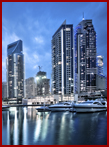
The spectre of the global financial crisis cast its shroud over not just Wall Street and the City, but the fledgling financial centres of the Middle East. John Foster investigates the fallout in Dubai, Bahrain and Qatar…
The way that Dubai had come to a virtual standstill was something to behold. Once, this tiny desert seaport had attracted one-third of the world’s cranes in an orgy of construction. Skyscrapers sprang out of the sands like flowers in the desert after the annual rains. Now those same cranes stand idle, skeletal shrines to Dubai’s over-reaching ambition.
Dubai is perhaps the most obvious victim of the global credit crunch, given that much of its prosperity was built on over $80bn (€54bn) of debt and an unsustainable real estate bubble, but the rest of the region is hurting too. Qatar and the other emirates of the UAE had been following Dubai’s brave lead, building up extensive developments and dabbling in man-made islands in the Arabian Gulf, in the hope that they would attract international tourism and create a financial services system to service mortgage loans and development costs.
Most of this was built on the easy accessibility of cheap money in the international credit markets. However, many of Dubai’s neighbours had access to treasure buried in layers of rock rich in hydrocarbons wealth, just below their desert sands or in the shallow and calm waters of their Arabian Gulf coasts. Dubai, not blessed with oil-wealth, put all its chips on black, and when the roulette wheel of the global credit markets stopped spinning, it came to rest on red.
The immediate outlook for much of the Gulf Arab states is not good, but in the longer term significant global economic power will emerge from the region. The GCC as a whole has had a number of decks stacked in its favour. The most obvious one is that it is, as an entity, the most significant supplier of the world’s energy needs. Countries will continue to need hydrocarbons to power their economies, and the Middle East offers the most easily accessible source of oil and gas. The demand for hydrocarbons will only increase as the global economy switches into recovery mode.
Qatar is the world’s third most significant producer of liquid natural gas (LNG) and Abu Dhabi, Dubai’s neighbour, has 10% of the world’s proven oil reserves. Both of these states have built up large foreign currency reserves in the past few years when oil prices were at a historic peak. Reserves saved for a rainy day, such as when oil prices crashed, as they did in the wake of the financial crisis.
Bahrain
Bahrain was the Dubai of the 1970s, and the world flocked to this tiny island state in the first oil boom, but faced with declining oil reserves and the geographical constraints of being an island, it declined in international significance. But since its first boom, Bahrain has had the chance to develop its economy, investing in oil-producing and refining facilities adding value to its and its neighbours’ main export. Bahrain has also developed into a regional centre of excellence for Islamic banking, with many of the most influential organisations in the industry jockeying for space in its financial district.
“Every country on earth has been affected by the recent global financial crisis,” says Kamal Ahmed, chief operating officer for the Economic Development Board of Bahrain, “but Bahrain has been fortunate in that we were much less affected than most. Our domestic banking system, for example, was not materially affected at all.”
When the spectre of the credit crunch appeared over the horizon, the Central Bank of Bahrain (CBB) intervened quickly “when two international banking groups, with Bahrain links, got themselves into difficulty – and our domestic banking system was not at all affected”, says Ahmed.
Bahrain was promoting itself as a financial centre in the 1970s and 1980s and it has, through a combination of attracting foreign talent, and sending its own intellectual capital to the developed world, created a robust regulatory system. As Ahmed argues: “One advantage we have enjoyed is that we had developed, over many years, a regulatory system in which the laws are transparent and regulation of the entire financial system is carried out by a single regulatory authority – the CBB. This way, market participants have the benefit of a straightforward system that is known, coherent and predictable.”
Bahrain has taken a best-practice approach to developing its financial services industry, working closely with foreign and international banks to create its regulatory system. Although it has drawn criticism in the past for being too conservative, aversion to heavy borrowing, complex derivatives and excessive reliance on real estate investment has seen the kingdom skirt the worst of the global asset crunch.
Qatar
The newest player is arguably Qatar. This tiny emirate, the joint richest country in the world by per capita income, has had the opportunity to create its financial regulations from a blank sheet and has deployed its impressive wealth to buy in the best expertise it could. Qatar’s watchword, like Bahrain, has been caution.
“Qatar’s economic welfare remains in relatively rude health; however it would be fair to say that even here a cautious approach has characterised the response of the financial and regulatory sectors,” says Steve Martin, director of marketing and corporate communications of the Qatar Financial Centre.
“The Government of Qatar has been proactive in shoring up the domestic banking sector with considerable capital injections allied to the buying up of stocks, shares and property portfolios. The underlying growth of the economy, buoyed by a raft of LNG deals with countries including the UK and Japan, has left Qatar relatively bullish about the prospects for 2010 with several key non-hydrocarbon sectors anticipating early growth in the first quarter of 2010,” he adds.
Spotlight on Dubai
Nonetheless, the spotlight remains firmly on Dubai, the region’s flagship economy. In the past few weeks, the story has rapidly moved. First there was optimism tingeing on euphoria, as Dubai successfully restructured its debt at the beginning of the year, thanks to a bailout from Abu Dhabi. In spite of this though, the calm exterior belied what was happening at the heart of Dubai Inc.
First came the sackings, with the November dismissal of Dr. Omar bin Sulaiman, the high-profile governor of the Dubai International Financial Centre since inauguration in 2004. The ruler of Dubai, Sheikh Mohammed bin Rashid al Maktoum, had a few days earlier reshuffled the board of the Investment Corporation of Dubai, a government company overseeing the government’s stakes in commercial companies such as Emirates airline.
The reshuffle removed three of the leading architects of the ‘Dubai Dream’ who were instrumental in Dubai’s transition from a regional trading centre to global business hub over the past decade.
The replacements were overwhelmingly from the ruler’s own family, tightening Sheikh Mohammad’s grip on Dubai. Hamdan bin Mohammed al Maktoum, the emirate’s crown prince and one of the net winners in the reshuffle, said that the global downturn “provided an opportunity to review our actions and assess the efforts that are needed to tackle” economic problems. To ram home the point that it was all change at the top he said: “The crisis has also shown the dangers of marginalising government’s role in the supervision of markets.”
But the drama did not end there as before the month closed, the property developer, Nakheel, one of Dubai’s marquee companies and an integral part of Dubai’s economic infrastructure made a request to suspend its debt payments. This sent a seismic shock around global credit markets raising the spectre that Dubai would be unable to meet its obligations and not complete the Palm, or numerous other half-finished projects, leaving Dubai and its coastal waters a disfigured, incomplete mess.
The problem that Dubai has had, in comparison with its neighbours, has really been one of disclosure – its leaders still maintain that the economy is robust, despite the facts staring them in the face; in fact it is “humming” according to Sheikh Hamdan.
But ask the many people who have been burned by the Dubai Dream, such as Rafi Hussein how ‘humming’ they are finding the economy and they will tell you the real story. Rafi spent six months unemployed in Beirut, and has since travelled to Doha to try and find work, on a much reduced salary and a much more junior level, in what many see as the next pearl to emerge from the Persian Gulf.
©2009 Funds Europe