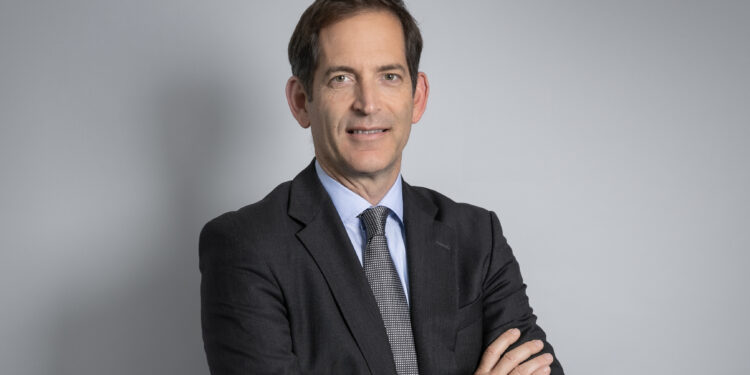
In the corridors of the City, the narrative surrounding private equity over the last three years has been one of seized-up fund raising and blocked exits. But sitting down with Georg Wunderlin, the CEO of Schroders Capital, one gets a different picture of momentum.
Since taking the helm in 2019 of Schroders’ private assets and alternatives division in 2019, Wunderlin has overseen assets under management (AuM) of the unit almost double from just under £44 billion to £81 billion, while also becoming the fastest-growing division of Schroders Group, as well as one of its profitable.
What was once a small number of investment desks predominantly overshadowed by Schroders’ public markets arm has been transformed into the sixth-largest private markets business in Europe, competing directly with pure-play giants like CVC and Ardian. It now accounts for roughly 9% of the FTSE 100 company’s group assets on a fee-earning basis.
“When I joined, private markets were a small part of the group,” Wunderlin says. “Now, by practically any publicly available measures, it is a significant private markets business in its own right.”
Mid-Market Alpha
While competitors gorged on large-cap buyouts fuelled by cheap debt, Schroders Capital deliberately positioned itself in the mid-market space.
The father of three describes the current state of the large-cap sector as suffering from “indigestion”.
“Many large cap managers are effectively stuck with their investments,” he says. “They’ve had the opportunity to buy assets with free leverage for a long period of time… and then all of a sudden the interest rate reversal happened and exits are now difficult.”
The mathematics of this stagnation are stark. Wunderlin notes that in a healthy ecosystem, the “cash-to-cash cycle” – the percentage of Net Asset Value (NAV) transacted annually – should be roughly 20%, assuming a five-year holding period.
“In the large cap space, this is currently around 11 to 12%,” he says, implying holding periods have blown out to nearly ten years, dragging down Internal Rates of Return (IRR).
“In the strategies where we are operating, it is practically unchanged… around 17, 18% last year,” Wunderlin says.
By buying companies at 4 to 7 times EBITDA and relying on operating profit growth rather than financial engineering, the firm has kept its liquidity cycle moving.
Consequently, while private equity fundraising globally has dropped for three consecutive years, Schroders has seen fundraising increase for three years running.
A Broad Church of Assets
Of the division’s $110 billion portfolio, the largest chunk sits in private debt and credit alternatives ($38.5 billion), followed by real estate ($31.2 billion), private equity ($25.5 billion), and infrastructure ($15 billion).
In credit, the firm has notably sidestepped the crowded sponsored direct lending market (financing leveraged buyouts) which Wunderlin views as oversupplied with capital chasing too few deals. Instead, the focus is on asset-backed finance and real asset debt.
The infrastructure division, boosted by the acquisition in 2022 of Greencoat Capital, is targeting opportunities in the energy transition, not just in wind and solar but also in hydrogen, battery storage and district heating.
“It’s really where for the next three decades, lots and lots of assets have to be built and ultimately owned and operated,” Wunderlin says.
Even in real estate, a sector Wunderlin admits has gone through “the mother of all crises,” the firm is finding growth by pivoting from core assets to value-add strategies in logistics, hospitality, and social infrastructure.
He points to the Knightsbridge Estate near Harrods as an example of their asset management capability – taking a high-value but tired portfolio and repositioning it for a client.
The Innovation Cycle
Wunderlin’s management philosophy is unsentimental. He describes a rigorous “innovation cycle” where business lines are reviewed strictly. “If it hasn’t grown within three years, we discontinue,” he states flatly.
This pruning led to the closure of its private debt business in Australia last year and a real estate unit in Munich to free up capital for faster-growing opportunities.
Wunderlin is supportive of the democratisation of private assets and the government’s Mansion House Accord, agreed in May, which aims to unlock the UK’s £3 trillion defined contribution (DC) pension cash for private market investment.
“It’s completely mad… that pensioners in this country used to have significant access to growth investments,” he says, “but now that the pension industry has shifted from defined benefit (DB) to DC, all of a sudden everyone is invested into passive equities and low cost investments, but no longer into infrastructure, private equity, venture capital and private credit.”
Schroders has been a pioneer in so-called evergreen or semi-liquid funds, launching vehicles that allow wealthy individuals and pension savers access to illiquid assets.
The firm now has five global semi-liquid vehicles and in September partnered with Hargreaves Lansdown to offer long-term asset funds via self-invested personal pensions (SIPPs).
The Road to 2027
Looking ahead, the ambition remains aggressive. Having hit the £72 billion mark roughly a year ago, the board’s immediate question was, “how quickly can we repeat the trick?”
The current target, announced by group CEO Richard Oldfield last March, is for Schroders Capital to generate net new business of £20 billion by 2027.
When combined with market performance, this trajectory aims to take the business to £100 billion in assets by the end of 2027.
At 55, Wunderlin describes himself as a “workaholic obsessed with the mission of growing the business”.
As the interview closes, the discussion turns briefly to tech investments and the fact that Schroders Capital was an early backer of Revolut, the London-headquartered neobank.
It seems a fitting footnote that a historic City name is backing the new disruptors, in the same way that Schroders Capital itself is disrupting the traditional boundaries of asset management.