
As US exceptionalism moderates and trade-related volatility surges, market leadership is expanding across a broader set of opportunities.
US equities and large-cap tech have outperformed for several years, largely thanks to tech-led innovation. While we still see opportunities in the US, other regions show signs of increased potential.
- European companies stand to gain from increased levels of fiscal stimulus, which could impact banking, defence spending and other aspects of the economy.
- Select Japanese firms, such as IT consulting firms, may draw strength from the country’s emphasis on investing in IT capabilities and infrastructure. Corporate governance reform is further strengthening the case for Japanese stocks.
- Opportunities are expanding within the US in areas like electric utilities, which, after decades of slow growth, may benefit from a surge in electricity demand.
Across regions and sectors, companies with accelerating earnings growth are emerging. In a broadening market environment, these dynamics are creating a wider range of opportunities for investors.
Signs of broader global growth in 2025
Over the last several years, global investors have generated strong returns by narrowly focusing on a small group of US growth stocks. Essentially, they just needed to take a position in US large-cap stocks — primarily those from the Magnificent Seven.
However, this trend may be changing as more businesses show stronger returns.
In recent years, a smaller percentage of companies outperformed the global index, especially in 2023 and 2024. See Figure 1. In 2025, the trend started to reverse, indicating that more companies are recording above-average growth.
Figure 1 | Growth Expands to a Larger Group of Stocks
Percentage of index names that outperform MSCI ACWI
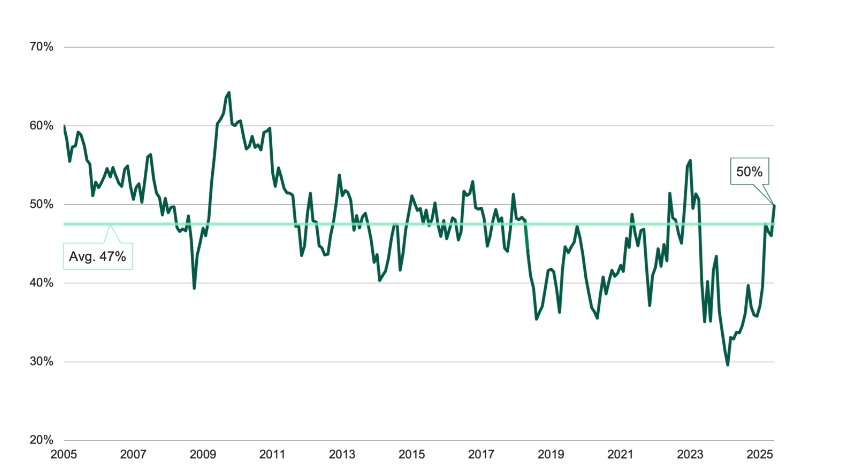
Data from 1/31/2005 – 5/30/2025. Source: American Century Investments. Past performance is no guarantee of future results.
Are the Magnificent Seven stocks losing market dominance?
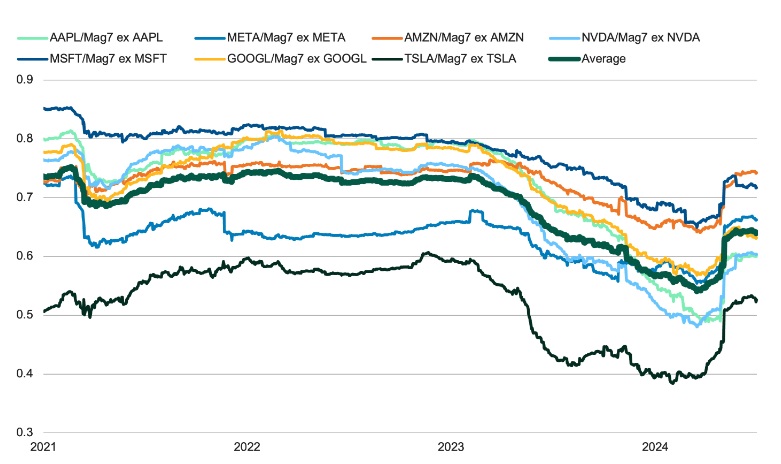
The Magnificent Seven supplied a large percentage of S&P 500 Index returns over the past few years. These stocks traded with a high degree of correlation with each other, even though they had different business exposures and business fundamentals. This highly correlated performance worked to the disadvantage of active managers who differentiated across the names.
Today, we are starting to see the correlation between these seven companies weaken as equity prices begin to reflect the fundamental characteristics of individual firms. You can see this shift in Figure 2, which shows the average correlation between each Magnificent Seven stock against the other six stocks in that group.
Figure 2 | Magnificent Seven Stocks May Be Trading Less as a Group
Historical correlation for each Magnificent Seven stock versus the other six
Data from 1/1/2021 – 12/31/2024. Source: FactSet.
This softening trend suggests that investors are beginning to evaluate and price each stock based on the underlying company’s fundamental characteristics and growth trajectory.
Finding growth potential in unexpected sectors and industries
We continue to see opportunities in the US, not just in the areas traditionally known for growth.
For example, we see increasing potential in sectors such as electric utilities. While utilities haven’t grown much in recent decades, that could change in the coming years. Electricity demand has been forecasted to rise thanks to artificial intelligence, clean energy adoption, CapEx spending on maintenance and general economic growth.
Unpredictability has been the watchword for 2025. Trade policy, geopolitics, and other forces constantly introduce new uncertainty into the global investment landscape.
However, we think attractive opportunities still exist. We feel that, by conducting thorough analysis and taking advantage of opportunities quickly and nimbly, active managers may be primed for this moment.