The Trump administration is aiming to devalue the dollar and at the same time push developed economies to buy long-dated treasuries, in a strategy that will make 2008 look like ‘a walk in the park’.
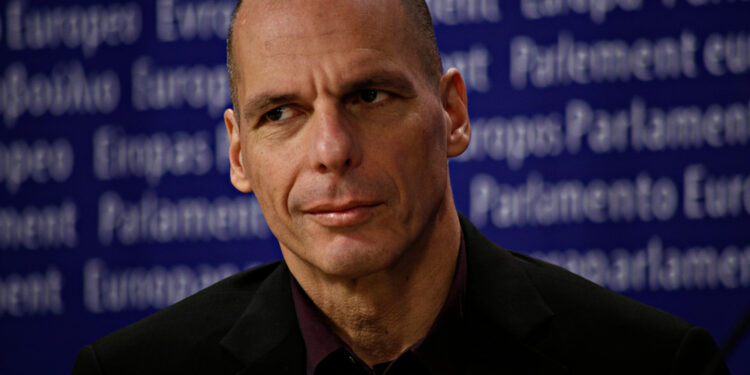
That was the assessment of Dr Yanis Varoufakis, the renowned economist, speaking at the FundForum conference in Monaco on Tuesday.
Varoufakis highlighted the aim of the Trump government to reduce the value of the dollar by 30 per cent, while reducing the US deficit by $6.6trillion over the next 10 years.
Varoufakis said: “Between 1950 and 1971, the United States essentially had created a dollar zone for all of us in Europe, in Japan, the United Kingdom, we had the dollar, we fixed exchange rates. We had a very planned regime, Bretton Woods. It was predicated upon the very simple idea. America was the only creditor and trade surplus nation, and it was recycling its surpluses to Europe and Japan, so that the Europeans and the Japanese would be sufficiently dollarised so that the dollars would go back to the United States. This was a recycling mechanism.
“Once the United States lost its trade deficit, Nixon, with Paul Volcker in the driving seat, blew up that system and reversed the recycling. The United States massively increased its trade deficit, not by accident, but by design, and made the rest of the world’s capitals pay for it by recycling their dollars back to New York.
“It was needed to deregulate Wall Street so that it would perform this recycling. Now, what the Trump administration has done is they’ve combined what I believe is a rational diagnosis – that this system after 2008 no longer works. That it is a clear and present danger of going into an implosion of the size, the volume of the dollar zone, due to the fact that the American manufacturing sector is now a tiny little organism, and the dollar zone is utterly parasitic on it.
“What they are actually, however, doing in order to cure the disease is probably worse than the disease itself. If you talk to Scott Besson, it’s clear that it is a means to an end. And what is the end? To devalue the dollar by around 30 per cent, on the other hand, to strengthen the dollar’s exorbitant privilege by forcing, for instance, the Japanese to unload half of $1.2 trillion in order to buy directly or indirectly long dated treasuries.
“The Genius Act, which is not that genius, was passed through the Senate the only other day. The emphasis is on stablecoins. Stablecoins are a way of privatising the dollar in the context of this ambitious twin aim that I mentioned before.
“$6.6 trillion is the Treasury’s estimate of that migration that is going to totally bend the yield curve and create financial instability and doom-loop between banks and stablecoin companies. This is going to move in the direction of Ethereum. Anybody who has studied Ethereum will know that the way in which assets are being traded, like NFTs on the basis of a private stablecoin, which supposedly is tethered to the US dollar. Imagine if in 2008 was it was not only running the weapons of mass financial destruction or the war in profit, but also it was running the dollar as a private enterprise.
“These are things to worry about. This is the Trump shock. This is the world that we are being introduced to and to which we must play a role in constraining in a manner that will avert something that will make the 2008 great financial crisis look like a walk in the park.”
Speaking to Funds Europe at the event, Henry Cobbe, head of research, Elston Consulting said: “Varoufakis’s speech sums up perfectly the ideas behind Trump’s rumoured Mar-a-Lago accord.
“Policymakers close to the Trump administration are reportedly advocating a plan to structurally weaken the US dollar and/or reduce the US’s debt cost burden.
“The big issue for asset allocators now is to make sure they get the right call on the direction of the dollar. That will be one of the biggest drivers of returns this year.”