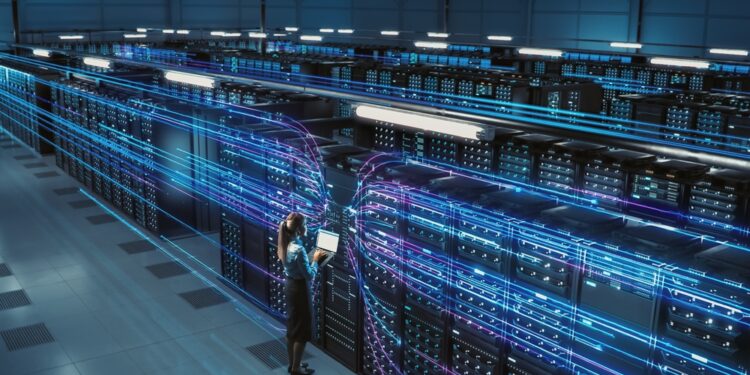
The rapid growth of artificial intelligence (AI) and the data centres aligned with it leads to concerns around sustainability. AI and data centres are rampant energy consumers.
For asset managers, the challenge is to reconcile the use of data centres for their own operations and for their investment portfolios (data centres are an exciting sector for real estate investors), with their net zero ambitions and ESG principles.
Siobhan Clarke, chief operating officer, investment management at Royal London Asset Management, recently told the FundsTech Forum that energy consumption of AI and data centres is “absolutely” a concern for asset managers. “It is not just our firm that is concerned, it is our clients. AI uses a vast amount of energy.”
Energy demand from AI data centres is set to quadruple by 2030 according to a report by the International Energy Agency (IEA). By then, the processing of data will consume more energy than Japan currently does and more electricity in the US alone than the manufacture of steel, cement, chemicals and all other energy-intensive goods.
A big factor in the growth of data centres is the growth of AI and generative AI specifically, according to Gregory Van Dan Top, AI practice leader, Europe for risk management firm Marsh Advisory.
OpenAI’s generative AI platform ChatGPT launched in November 2023 and within two months the platform had hit 100 million users – a milestone that Facebook, Instagram and Netflix took years to reach.
The IEA report states that most data centres use the equivalent of 100,000 households when it comes to electricity. However, data centres currently under construction could consume 20 times that amount. It has also been reported in recent weeks that the EU is planning to build AI gigafactories in a bid to catch up with Asia and the US.
The Stargate Project, a US-based joint venture between OpenAI, SoftBank, Oracle and investment firm MGX, plans to invest up to $500 billion in AI infrastructure in the US by 2029. Meanwhile, Europe has launched the InvestAI initiative in order to mobilise $200 billion of investment in AI, including a European fund worth $20 billon for AI gigafactories.
21st century’s explosion in data
Van Dan Top says the 21st century has heralded an explosion in data, fuelled by three developments: the adoption of social media and cloud technology; the streaming of content creation; and the birth of AI platforms.
“As AI continues to gain momentum, the trend will only continue,” says Van Dan Top.
While AI poses numerous risks in terms of disinformation, data privacy, loss of human autonomy and malicious misuse, it is arguably the environmental impact that could pose the greatest threat, according to Van Dan Top.
He highlights five such risks caused by the surge in AI and data centres demand:
- Enhanced energy requirements due to data centres vast energy consumption which in Europe is forecast to rise from 62 TWh to 150 TWh by 2030
- Increasing resources requirements and the impact on biodiversity
- High land use and land clearing to accommodate large data centres – European data centres are set to expand by 22% in 2025, equivalent to 9m sq m
- Growing e-waste – data centres built for generative AI will produce millions of tonnes of electronic waste by 2026
- Delay in energy transition as the surge in electricity demand caused by the increase in data centres. For example, Omaha Coal Plant in the US has stated it will keep its coal-burning units online up to 2026 to support data centre demand in its region.
Root cause and solution
Certain steps have been taken to address these environmental risks. A number of European data centre operators and trade associations have signed the Climate Neutral Data Centre Pact to achieve net zero by 2030.
Many operators are transitioning to lithium-ion UPS systems with extended lifespan expectancy. Some European operators are also looking to limit their use of fossil fuels. For example, energy consumption of data centres in the Netherlands is just 0.44% of the country’s total consumption with 99% energy sourced from green resources.
And then there is AI itself, which Van Dan Top describes as “both the root cause and the potential solution to the modern data centre’s sustainability conundrum”.
For example, while the emergence of AI platforms has been a key contributor to the surge in energy demand, the technology is also capable to analysing and adapting energy consumption as well as making predictions about future energy demands to adjust cooling settings and allocate resources accordingly.
For asset managers looking to manage the internal risk of using data centres for their own operations, there are some steps that can be taken, says Van Dan Top. “Few companies will be developing their own data centres and instead will be relying on third parties, so investment firms and their risk managers should be influencing the procurement process and the environmental risks. They should also monitor the environmental impact of AI and establish KPIs with third-parties to ensure the technology is being used efficiently and appropriately.”
Investor concerns
But it is not just an internal operations issue. Data centre sustainability is also becoming more important for portfolio managers and their investors, says Luciano Lilloy, portfolio manager at Impax Investments.
From a portfolio manager’s perspective, it is not just the data centres but the many companies within the supply chain – for example, chip-makers, hyper-scalers, hardware providers, suppliers of cooling equipment, data centre managers.
“It absolutely should be on every investors’ radar,” says Lilloy. “You have to understand what companies are using in terms of data centres and emissions and whether that is increasing.”
Disclosure around sustainability is still not great but we are in a much better position than we were 10 years ago, says Lilloy. “Most companies provide Scope 1 and Scope 2 data but there is value in going beyond that and engaging with the company and really understanding the use of emissions and including Scope 3 emissions data.”
There is a huge opportunity for those companies that can help other companies in the data-centre supply chain to reduce the carbon footprint, says Lilloy. “Hyper-scalers and other companies in that data centre supply chain would be willing to pay a premium for such a product or a service because they have their own net zero targets and want more operational efficiency.”
There are also encouraging technological developments, such as the increasing efficiency of hardware, says Lilloy. Chips have a longer shelf-life as well as more efficient use. This means that there is less energy waste.
“There are two processes involved with AI – training and deployment,” says Lilloy. “Equipment would typically be used for three to five years and then retired, but we are seeing systems being used for five years for training and then kept and used for deployment rather than scrapped.”
“Following the power”
Marigold Look, executive director at IFM Investors, an asset manager focused on infrastructure assets, agrees that investors are increasingly aware of the risks around data centres and their implications for long-term sustainability and performance.
“Environmental risks, energy consumption, and sustainability measures are increasingly being considered as part of investor due diligence and disclosure reporting,” she says. “As the digital economy continues to expand, data centres, which require large and stable amounts of electricity, are being assessed for their ability to meet sustainability and net zero targets.”
This includes evaluation of energy efficiency measures, renewable energy sourcing, and the capacity to integrate with other infrastructure such as power generation and storage. “These factors are critical to understanding the long-term viability and environmental footprint of data centre investments,” says Look.
Operators are increasingly ‘following the power’ by co-locating data centres with renewable energy sites, says Look. “This can provide guaranteed power (with storage), reduce transmission and distribution charges, and lower curtailment risks. The integration of batteries is expected to grow as demand increases and costs decline.”
In the future, continued growth in renewable capacity, expected to be driven by solar and wind, together with advancements in grid and data centre technologies will help lower the carbon intensity of the electricity mix.
Technological improvements also include advanced design, such as optimising cooling methods, that can significantly improve energy efficiency. Using temperature and humidity monitors to manage an efficient cooling response can help optimise operations and minimise energy use.
“Overall, a combination of smarter infrastructure, cleaner power, and new technologies is helping the sector move toward more sustainable operations,” says Look.