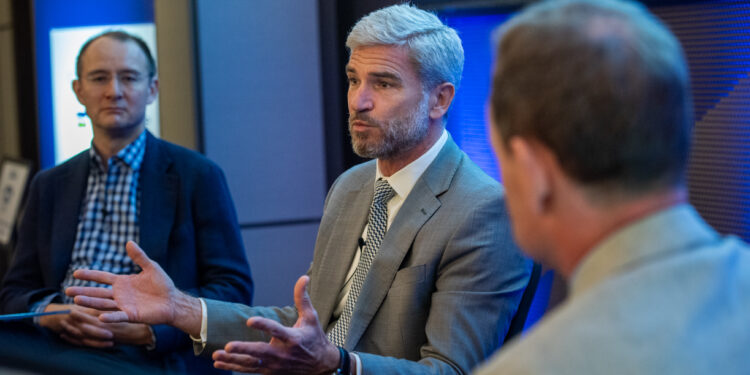
One of the FundsTech Forum 2025 fireside chats held in London today featured leaders from two asset managers shaping the future of digital assets — Robert Crossley, head of digital asset and business advisory services at Franklin Templeton and MJ Lytle, CEO of Janus Henderson Tabula.
They shared insights into their recent advances — from Franklin Templeton’s tokenised money market fund launch to Janus Henderson’s achievement of a high quality credit rating for one of its tokenised funds, setting a new benchmark for the industry.
The Janus Henderson Anemoy Treasury Fund has received an AA+f / S1+ fund credit quality rating from S&P Global Ratings. This is currently the highest rating assigned to a tokenised fund, and one step below S&P’s top rating.
Moderator Nick Fitzpatrick, editor, Funds Europe, asked the panellists what it takes to get a favourable rating for a tokenised fund. Among other aspects, is it also a vote of confidence in the underlying crypto custodian and the distributed ledger technology?
S&P ratings are among the most globally respected, reinforcing universal benchmarking, transparency and business growth. MJ Lytle, CEO of ETF provider Janus Henderson Tabula, acknowledged that navigating tokenised fund structures is less about having all the answers and more about knowing what questions to ask. “The challenge with tokenised funds is identifying the right questions to spot the risks,” he said. “It’s about tackling new technology rapidly — and that’s not easy in our industry.”
Lytle explained that while rating agencies are often “one step behind treasuries,” their involvement is valuable in bringing structure to complex emerging technologies. “S&P had a specialist who understood the technology and protocols — that was helpful for everyone trying to wrap their heads around it,” he noted. In his view, ratings become particularly relevant when new tech is introduced into mainstream fund management.
On the broader topic of tokenisation, Lytle raised concerns about the industry’s readiness for the scale and speed it promises. “The real question is stablecoins — we need a truly end-to-end digital solution,” he said. Instant settlement in a tokenised world is a matter of minutes. If the technology doesn’t allow for traditional liquidity providers to participate, he said, “you end up with problems.”
Operationally, he argued, the industry often overlooks a key factor: cost. “We’re under cost pressure, but operational costs in this space are often not even taken into consideration,” he said. The real goal, he added, should be to ask: How do we create a non-linear change in costs? That’s where meaningful reduction lies.
Janus Henderson’s tokenised fund gets highest S&P rating
One of the biggest barriers, Lytle admitted, is communication at the board level. “Talking to the board is the hardest part — it’s like speaking a different language,” he said. Within asset management, the real opportunity lies in identifying “blocks of opportunity” that can serve as entry points to broader transformation.
The timing of the shift from traditional to digital fund models remains uncertain. “We don’t know at which sudden point funds will tip into digital,” said Lytle. Regulation, he added, is still a long way off from regulators properly addressing the operational challenges and opportunities here. Finally, he called for stronger leadership across the tokenisation value chain.
Robert Crossley, head of digital asset and business advisory services at Franklin Templeton, believes that the future of responsible investing relies on technology that sits outside the boundaries of traditional finance. “Investing in wealth creation is increasingly dependent on tech beyond legacy systems,” he said, pointing to the limitations of static solutions in the current financial infrastructure.
In a Web3 and blockchain-enabled world, composability is the standard, Crossley added. “It’s no longer just about the assets themselves — it’s about capital efficiency and professional efficiency, particularly when it comes to cost control and collateral reconciliation.”
Citing a Ripple and Boston Consulting Group report, Crossley highlighted that the market for tokenised assets, including stablecoins and tokenised deposits, is forecast to reach $18.9 trillion by 2033. The report gives a framework of three adoption stages, with the current phase focused on low-risk pilots in assets like money market funds and corporate bonds, aimed at building institutional readiness before full-scale transformation.
Franklin Templeton gets CSSF nod for “first” fully tokenised Ucits fund on public blockchain
Franklin Templeton recently received approval from Luxembourg’s financial regulatory authority CSSF to launch Europe’s first fully tokenised Ucits fund on a public blockchain. Powered by Franklin’s proprietary blockchain-enabled transfer agency platform, the fund is expected to enhance “transparency, security, accuracy, and transaction immediacy” for investors. It will be distributed across Europe in the coming months, subject to further regulatory clearance.
Crossley reflected on the deeper implications of these technologies. “All technology redraws the line between alpha and beta — between what’s valuable and what you can charge for,” he said. This shift, he added, introduces both opportunities and challenges. “The bigger question is, fast forward five years — if firms lack capability in new tech, what happens to their competitive advantage?”
He sees stablecoins as a key bridge between the digital and traditional financial systems. A money market fund that settles in real-time, for example, is “strategically significant for clients” and part of a broader suite of future-focused products aimed at enhancing asset utility.
For Crossley, the pathway to the future doesn’t rely on “one big bang moment” but on a gradual evolution. “Functional infrastructure, education, product and process — it all has to move together,” he said. The benefits of tokenisation, from improved settlement to increased accessibility, are becoming more and more tangible. “The move from accounts to wallets is fundamental,” he concluded. “Assets will become more programmable.”