EU policymakers need look no further to find out what German asset management leaders think of their policies. Read the first of three reports of a high-level asset management roundtable in Germany here.
Participants:
- Dirk Degenhardt, CEO, Deka Wealth Management (DWM)
- Hans Joachim Reinke, CEO, Union Investment
- Dr Matthias Liermann, global head of product management and chief country officer, Germany, DWS
- Ingo Mainert, chief investment officer multi-asset Europe, Allianz Global Investors
- Thomas Richter, CEO, BVI
2024 marks a decade since the European Commission launched plans for the Capital Markets Union (CMU). By now, billions of euros should be travelling freely across national borders, bolstering the EU economy. It should be a happy anniversary.
But some of the most senior asset management executives in Europe are disappointed by progress in unifying the EU’s capital markets system.
Dirk Degenhardt, CEO at Deka Wealth Management, said: “The CMU should have helped the EU to become more competitive at the global level, but what we’ve seen very strongly in recent years is more bureaucracy due to regulations. As a result, the EU particularly lost competitiveness compared to the US.”
Dr Matthias Liermann, global head of product management & chief country officer for Germany at DWS, said the CMU had not only lost momentum, it had “gained partially negative momentum”.
Read the second feature from our Germany roundtable here
Read the third feature from our Germany roundtable here
“Building castles in the air”
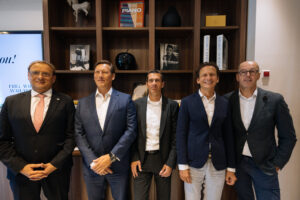
The two executives were speaking at a special Funds Europe panel discussion held in Frankfurt during the summer that featured four of the largest asset managers in Germany, along with Germany’s national trade body for funds, the BVI.
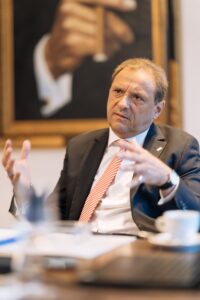
“The CMU was always very top down, esoteric and essentially a romantic notion that is not down to earth”
Ingo Mainert, chief investment officer multi-asset Europe, Allianz Global Investors
Hans Joachim Reinke, CEO at Union Investment and Ingo Mainert, chief investment officer multi-asset Europe at Allianz Global Investors, also took part in the discussion, along with Thomas Richter, CEO of the BVI. The panel spanned topics including infrastructure investing and sustainability.
Ingo Mainert of Allianz GI said the CMU project had been approached from the wrong end – “top down” when it should have started from a base of individual member states, each state identifying what had worked well for them and proposing best practices to be shared.
Saying the CMU was like “building“ castles in the air”, he added: “The CMU was always very top down, esoteric and essentially a romantic notion that is not down to earth.”
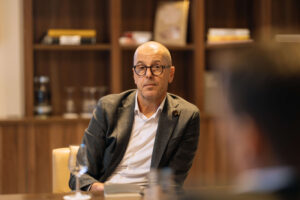
Hans Joachim Reinke of Union Investment said short-termism by politicians was part of the problem. “The priorities of politicians – including for example in the case of infrastructure development – are not long-term at all. They exclude the long-term because a politician never reaps the benefits of their decisions if they do not get re-elected.”
UK politician Jonathan Hill, now Lord Hill, led the CMU following its introduction in 2014 when he was appointed European Commissioner for Financial Stability, Financial Services and Capital Markets Union. The project is intended to increase capital flows across European borders by reducing bureaucratic and legal frictions.
The UK’s subsequent departure from the EU was seen by the executives as one cause of the CMU’s derailment.
“We can’t get any scale”
Dr Matthias Liermann, the DWS executive, said that European financial market activity had decreased from 18% of global market share to 10% in the last few years and was a quarter the size of the US even though the EU has three-times as many exchanges.
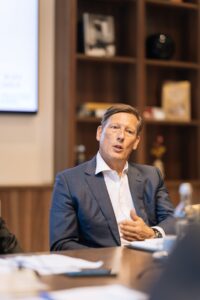
“This shows how fragmented we still are at the national level. We can’t get any scale in there at all.”
Thomas Richter from the BVI said that the fund industry had a natural interest in a CMU and had originally been enthusiastic about the idea. However, he described CMU progress as “relatively disappointing”, saying there had not been many impactful initiatives beyond “changes to prospectus policies, small things like that”.
Dr Matthias Liermann echoed this. “We got lost in the small stuff,” he said, while Thomas Richter added that the European Commission had driven the CMU project, but that Member States had been “more or less apathetic towards it”.
Signs of change?
However, the BVI chief also said there is a possible building of momentum again due to changing economic circumstances globally.
“The tide has changed somewhat in that member states can no longer finance themselves at zero percent interest rates. State financing has become more expensive, which in turn makes the financing of infrastructure more expensive, too, and there is a little more support now from EU member states to create a capital markets union.”
He pointed to an April 2024 report called ‘Much more than a market’, penned by Enrico Letta, a former prime minister of Italy. The report emphasises the need for integrated EU capital markets but goes beyond the CMU to create a Savings and Investments Union.
Similarly, a French group earlier this year headed by Christian Noyer, former governor of the Bank of France, was called on to restart the CMU project and consult on proposals.
However, Thomas Richter said that these two initiatives had produced “flowery” ideas.
“They are very surprisingly thin and the only really hard core to this is the desire of the French – which was already known – to make Esma a European SEC,” he said, in relation to the main market regulators of the EU and the US, respectively. “And that’s where I think we have to be a little bit careful about whether this interest is just ‘bait’ that serves to promote agendas, such as centralising securities supervision with Esma in Paris.”
Ingo Mainert of Allianz GI also noted that interest in the CMU had returned since interest rates had moved higher in the past two years.
“Mr Macron [French president] has pushed very hard and possibly momentum is now returning. But the CMU may become part of a larger discussion and this is where I say again that there may be too much emphasis on the top down when really the issue needs to start at the national level.”
He recounted the EU phrase ‘Think European, Act Local’ – but emphasised a need to act local first.
“I believe that individual member states should assess what their needs are from financial markets, identify any best practices, and consider where national regulation is currently working well.”
“Centuries of banking culture”
The panel said that wider solutions beyond politics were needed from the private sector – but also that a re-assessment of cultural attitudes to finance may be holding back the CMU.
Hans Joachim Reinke of Union Investment said: “It is important for politicians in Germany and broader Europe to understand that we as asset managers are part of the solution and not part of the problem. That might have been different during the 2008 financial crisis, but things have changed.
“Major issues facing the EU are sustainability and demographics, which can only be solved through private capital. It would be naïve to believe that politicians can solve this through government actions alone because they do not have the resources and they do not set the right priorities.”
Ingo Mainert of Allianz GI suggested cultural attitudes to finance could be holding back the CMU. “The core European financing regime is centred on banks. You just have to look at bank balance sheets in relation to gross domestic product to see this.
“We have a lot of catching up to do with America and other countries. The Americans have a capital markets-based financing system – roughly 70% capital markets, versus 30% bank finance.
“Europe is vice versa, while Asia is approximately at parity with 50-50. We have a cultural change on our hands here. Our financing system has been bank-based over many, many decades, even centuries. That is why a CMU may be easier said than done.”
He said the EU should aim for a balance of 50-50 between bank debt and capital markets – similar to Asia – rather than going from one extreme to the other.
Infrastructure & private markets
Rebalancing finance like this and allowing capital to more freely travel across borders would aid asset managers to have a greater impact on some of the EU’s biggest challenges, which the panel described variously as demographics & pensions, sustainability, and infrastructure.
Solving the infrastructure problem needs more private markets participation from asset owners and from asset managers. Infrastructure is a major asset class within the ‘alternative’ investment universe, where asset managers act in private equity and private debt.
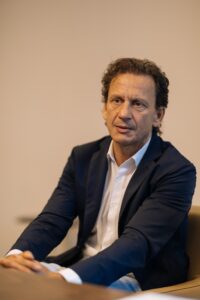
“It is currently difficult to work as an asset manager for private markets in Germany, because there is a risk of double taxation – and that’s why no one stays here”
Thomas Richter, CEO, BVI
Pension funds and other investors have made greater allocations to private markets in pursuit of diversification and growth and ‘traditional’ asset managers have increased their private markets expertise as a result.
Regulators have supported the movement of private capital, most recently by amending rules for the management and distribution of European Long-term Investment Funds (Eltifs).
Sometimes known as ‘semi-liquid’ funds for their combination of public and private investments, the Eltif – and the UK’s similar Long-term Asset Fund – lead the charge to ‘democratise’ private markets by making it easier for smaller, less sophisticated investors to access these illiquid assets.
Dr Matthias Liermann at DWS noted that an advantage of the Eltif would be to boost infrastructure development, for which there is an “immense” need in Germany and elsewhere in Europe.
“Upgrading infrastructure is a mammoth task and the need for investment is enormous. However, we have not yet created the conditions for pension funds to invest significantly in infrastructure. They have to go outside of their permitted investment buckets to do this. The need for private capital is very high and the Eltif could mobilise private capital and become a building block for portfolios.”
But there needs to be a faster approvals process, he said, along with greater planning security for infrastructure projects such as renewable energy. And then there are technical issues that the state has to take into account, such as premiums, depreciation and discounted financing.
Additional obstacles in Germany
He warned the impact of the Eltif would be limited, particularly in Germany.
“I don’t think the Eltif will provide a significant contribution to the financial needs. Added to this is a lack of investment opportunities and any opportunities that exist will not necessarily be in Germany, where our experience tells us there are many bureaucratic obstacles to investing in private markets.”
As an example, he said mixed financing – where private individuals can participate in projects founded by the state – did not exist in Germany.
Dirk Degenhardt of Deka said he was confident that policymakers would recognise a role for the funds industry in supporting infrastructure, but that they would have to recognise and reduce bureaucracy where state and private finance meet.
A particularly difficult situation for German infrastructure development is the fact that few private-market managers establish themselves in Germany due to the bureaucratic regime our panel described.
“Brutal” home-bias
Dr Matthias Liermann of DWS said that fund managers were statistically more likely to invest in infrastructure in their country of domicile, and the BVI’s Thomas Richter described this home-bias as being “brutal” for Germany owing to a lack of private-capital managers established there.
He said that asset managers, including German firms, were disincentivised to establish offices in Germany. “It is currently difficult to work as an asset manager for private markets in Germany, because there is a risk of double taxation – and that’s why no one stays here. German asset managers who are in this business usually have branches in London, Zurich or Paris. Italians have now also followed suit.
“This and the strong home bias mean that if a German asset manager is located abroad, there is a great risk that the manager will not invest in an infrastructure facility in Germany. At the moment, a lot of German money – especially institutional – is flowing into infrastructure. But in most cases this money is then invested abroad because of these tax problems in Germany.”
However, he expressed optimism that a bill currently passing through German parliament would mend this situation and indicated the need for German tax rules to be brought into line with the wider EU.
Eltif v 2 – a step in the right direction
Beyond this particular issue for Germany, Hans Joachim Reinke of Union Investment also highlighted that investors across the EU would have to become comfortable with alternative assets for the Eltif to succeed as a product because these investment vehicles are geared towards smaller pension funds and other less sophisticated investors that have never considered private assets in the past.
Dirk Degenhardt of Deka said recent changes to the Eltif rules – known in the industry as ‘Eltif v2’ – were “exactly a step in the right direction” for making the product easier to appeal to a broader range of investors.
He nevertheless expressed reservations about the target market’s ability to embrace private assets due to the illiquid nature of private equity and debt.
“For me there is a big question around how we as an industry can explain these products to investors through our sales departments to retail investors in a way that means these products are sold correctly.”
The risk profile of the typical retail customer needs to be carefully considered.
Are these channels a logical route for Eltif distribution?
“Admittedly, that’s still a bit difficult from my point of view,” said Dirk Degenhardt of Deka. “How do I implement this building block in a specific asset allocation, knowing full well that it is illiquid?”
He added: “I think this is a huge challenge. In my view, it is much easier to present the risk profile of a stock or bond – even of a classic private equity or infrastructure investment. But this combination of public and private markets assets seems to me to be highly complex in terms of risk profile for retail customers.”
He argued institutional investors and private banking and wealth management clients should be the primary target group for these products.
“The interest in sustainable investing may have fallen behind a little for customers, but the need to deal with the issues of sustainability is not decreasing. In fact, it is increasing. That’s why we will continue to do this with all our might.”
Hans Joachim Reinke, CEO, Union Investment
Dr Matthias Liermann of DWS agreed, pointing out that investment advisers were generally risk averse and would, given a choice, prefer to channel customers into simpler products. He also considered the lack of a stock culture in Germany to be a hindrance.
“We don’t have a stock culture yet and yet we are going one technical step further into infrastructure and other illiquid investments.”
Thomas Richter of the BVI said that open-ended real estate funds – which are retail vehicles but with lower liquidity than typical retail investment funds – have been popular in Germany, suggesting this bodes well for the Eltif’s success. Dr Matthias Liermann agreed but added that these funds had also seen many dissatisfied customers and a slew of court cases.
ESG “does not mean lower returns”
As well as being an anniversary for the CMU, 2024 is famously the year when more general elections take place in a single year than ever before. But this happens at a time when politics has swung to the right.
For Hans Joachim Reinke of Union Asset Management, the rightwards-leaning sentiments of the populous are a factor that has “pushed sustainability into the background”.
The panel of German asset managers considered the progress made by sustainable investment and noted that sustainable investing – or broader ‘ESG’ – had in the past two years faced a challenge that stems from lower returns for these funds in comparison to funds with no specific ESG criteria.
“The whole topic of sustainability has fallen behind in the public discussion because in 2022 – due to the Russian invasion of Ukraine – we had to face the fact that for the first time, sustainable investments were performing worse than traditional investments,” said the Union Asset Management CEO.
The big question that all asset managers have to explain to customers, he said, is: Will ESG investing deliver lower returns?
Emphatically, he said, the answer is “No!”
Many observers have noted that 2022 saw energy stocks rally after Russia’s invasion of Ukraine, which will have impacted sustainability funds that either excluded oil companies and other fossil-fuel stocks, or under-weighted them in line with ESG reference benchmarks.
“The interest in sustainable investing may have fallen behind a little for customers, but the need to deal with the issues of sustainability is not decreasing. In fact, it is increasing. That’s why we will continue to do this with all our might.”
The “sustainable inquiry”
Dirk Degenhardt of Deka said the “sustainability inquiry” as a part of the suitability assessment is too complicated for both customers and consultants.
“Why I think the topic of sustainability is stalling to some extent in sales, especially among private investors, is the excessive complexity required by Mifid II and national regulators. When a consultant takes a customer through the sustainability process, it gets down to the level of what PAIs [principles of adverse impact] are important to the customer. That’s absurd. Which consultants and clients are truly capable of discussing these granular topics such as biodiversity in the required depth?
“If we want sustainability to become more important to private customers again, then we have to simplify and talk on a level that customers can understand and which consultants can also convey.”
Ingo Mainert at Allianz GI noted German Chancellor Olaf Scholz’s comment that February 2022 had marked a “turning point” (“Zeitenwende”) by putting a sharp break on the too euphoric discussion regarding sustainable investing. Defence and energy safety came back into the markets’ mind.
There is definitely a need to reduce complexity in sustainable investing, with a focus on defining key terms such as ‘impact’. This focus should now also incorporate “remilitarisation”, he proposed, for instance as part of the discussion within the ‘S’ – social – bucket of ESG.
Effecting the transition
Hans Joachim Reinke of Union Investment pointed out that only 2-5% of stocks in the MSCI World Index are assessed as sustainably green.
“To effect a transformation, we probably have to invest in stocks that do not sit well with green values today and we need to find a credible approach to transition within this.”
He said contradictions existed between regulatory aims for a green transition, and what investors can actually achieve.
“There is a huge inconsistency between what is wanted politically and what is done in regulatory terms.
“If we say that ecology needs the economy and the economy needs finance, then it can only work if we encompass values that are not yet green at this moment. That’s not a difficult thing to understand but not every politician does understand this.”
Hans Joachim Reinke, of Union Investment said it was a “German problem” that well intentioned political aims could be made complex and even impossible by regulation. Yet he also pointed to the success of the BVI in lobbying the German government to support an ambition for “every roof of our properties” in real estate funds to have solar power panels installed.
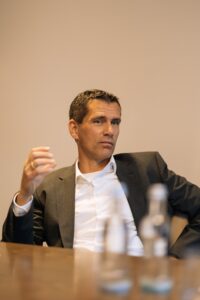
“If we want sustainability to become more important to private customers again, then we have to simplify and talk on a level that customers can understand and which consultants can also convey.”
Dirk Degenhardt, CEO, Deka Wealth Management (DWM)
Dr Matthias Liermann of DWS said regulation around sustainable products at the national level, coupled with ESG ratings that investors “sometimes no longer understand”, had added to complexity.
“These days I can read through a prospectus for ESG funds and even as a lawyer I sometimes start to question the meaning of all the regulatory required ESG details. These should be documents that are easy to understand.”
And he added: “Nuclear power: is it good or is it bad? The French say it is sustainable and therefore good. The Germans say it is not good.”
“Incredible mass of rules”
Thomas Richter of the BVI said the EU was losing its way on sustainability issues.
“Six years, through the green taxonomy the EU started regulating every detail related to the transition, looking at which activities in, for example, the transport sector or the chemicals sector needed to be evaluated from an environmental point of view. The result has been an incredible mass of rules.
“The perverse thing about this development was that asset managers even partly wanted this because they felt it would give them security regarding what was allowed and what wasn’t allowed. This was seen as a protection against greenwashing offences. But it led to firms depriving themselves from the ability to make their own decisions.
“Now we’re here with a jungle of rules that no one really understands anymore and that’s not a success otherwise it would have been copied by other countries. No-one is copying EU sustainability legislation”
Thomas Richter, CEO, BVI
“Now we’re here with a jungle of rules that no one really understands anymore and that’s not a success otherwise it would have been copied by other countries. No-one is copying EU sustainability legislation.”
Ingo Mainert at Allianz GI said the industry had learned some important lessons about ESG in recent years. The three components of ESG – environment, social, and governance – were not correlated and likely could not, therefore, be uniformly regulated. “There is no ‘one size fits all’ here”, he said. Still, he generally finds it helpful to use these three letters as a guide.
ESG is a “dynamic structure” that changes over time, he said. Dr Matthias Liermann at DWS reflected this point, saying how a lack of data quality in, for example, the debate about nuclear as a ‘clean’ energy meant sometimes ESG investing can be driven more by “the spirit of the times” than by facts.
And echoing Ingo Mainert’s earlier comments on how “remilitaristion” might shape ESG investing, Dr Matthias Liermann pointed out that the Russian invasion of Ukraine could be changing investors’ views towards arms stocks.
A changing spirit of the time, indeed.
*This article was produced by Nick Fitzpatrick, editor, Funds Europe, and Markus Hill, a Frankfurt-based freelance journalist.