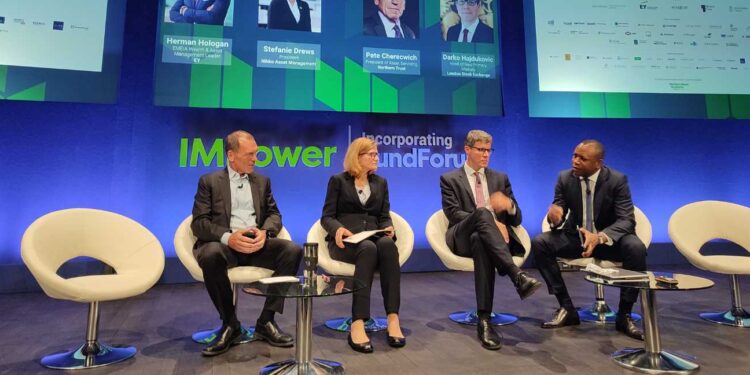
A panel discussion took place on the first day of FundForum 2023 in Monaco, focusing on the most important transformational trends for end customers and stakeholders in the wealth and asset management industry.
Hermin Hologan, EMEIA wealth & asset management Leader at EY, delivered the introductory briefing at the Seven trends shaping the investment management industry panel discussion and emphasised the global megatrends that reinforce the role of asset managers.
Hologan shared data from reputable sources such as the World Health Organization, Coinbase and The Economist, which projected significant developments in demographics, healthcare costs, investor demands for ESG data, asset movement by millennials and women’s ownership of wealth.
By 2030, it is estimated that there will be 1.4 billion people aged 60 and older, healthcare costs will increase by 64%, more than 50% of investors will demand ESG data, millennials will be more than twice as likely as boomers to move assets and women will own 55% of the world’s wealth.
Hologan highlighted several key trends shaping wealth and asset management today, including technology, energy, sustainability, governance (ESG) investing, product innovation, cost transformation, private markets, ecosystems and talent management.
He emphasised the role of technology as a business and operational accelerator, the increasing importance of ESG investing, product innovation driven by changing investor preferences, the transformative power of cost management, the opening of private markets to a wider investor base, the growing significance of ecosystems and the adaptation of talent management to new work models.
During the panel discussion, Stefanie Drews, president of Nikko Asset Management, highlighted the increasing integration of sustainability into investments in Asia.
She drew inspiration from the sustainability-focused regimes in Europe and mentioned that Hong Kong and Singapore are now implementing their own sustainability-focused initiatives.
Pete Cherewich, president of Asset Servicing at Northern Trust, provided insights into the investment landscape, stating that 40% of new funds launched last year were private market funds. He noted that private markets continue to gain momentum, particularly in the private credit sector, which is growing slower than private equity.
Darko Hajdukovic, group head of new primary markets at the London Stock Exchange Group, acknowledged the challenges of entering the private asset class but highlighted the changing landscape. He emphasised the importance of healthy private markets for the overall health of public markets. He said The London Stock Exchange Group is actively working on solutions for private markets and aims to create a seamless transition between public and private markets by providing capital to private companies.
Fadi Abuali, CEO of Goldman Sachs Asset Management, disagreed that private equity is dead, calling it an interesting asset class that has performed well during periods of high inflation and volatility since the 1970s and 1980s. He pointed out that bid-offer spreads are shrinking, creating attractive opportunities and predicted an interesting time for private equity in the next 12-18 months.
Regarding sustainable investments, Pete Cherewich emphasised the importance of “doing the right things”. He mentioned that the London Stock Exchange Group facilitates carbon-neutral investments by setting standards for companies. Fadi Abuali highlighted the long-term relevance of ESG, irrespective of political views, emphasising the need for a forward-looking approach.
Fadi Abuali also mentioned the growing interest in social bonds and green bonds, particularly in sectors such as housing, healthcare, education and green energy transition.
Stefanie Drews emphasised that talent management is about creating an environment that fosters good performance. She provided examples from her company, mentioning investments that enable work-from-home, language translation and more, which open up opportunities to attract talent. Abuali added that scale and engineering expertise would be differentiators in an alpha generation.
In conclusion, while the panel discussed various transformative trends, it was agreed that governance (G) takes precedence over geopolitics as the primary focus of ESG. The industry leaders remain committed to staying ahead of these trends to shape the future of wealth and asset management.
© 2023 funds europe