Low-vol strategies reflect how investors’ mentalities have changed since 2008. Fiona Rintoul looks at a fund market that is hard to uniformly categorise and finds good performance.
“In Russia, we have a proverb,” says Alexei Jourovski, head of equities at Unigestion. “Every new thing is a well-forgotten old thing. This applies to low volatility investing.”
Low volatility may be in vogue at the moment, as investors caught in turbulent and unpredictable waters grab at anything passing that looks like it might float, but it is far from new. For Jourovski, it simply continues what Warren Buffett said about money management: don’t lose money. For others, it is an idea that has been around for decades; it just didn’t light up many rooms prior to the 2008 global financial crisis.
“There’s usually not a lot of interest in low volatility investing in up markets,” says John Calamos, chief executive at Calamos Investments. “Now everybody is trying to figure out a way to cope with the uncertainty in the market environment. low volatility investing is not a new idea but too often it’s positioned as something new.”
Illinois-based Calamos Investments has been running low volatility portfolios pretty much since John Calamos set the company up in 1977. Its two main strategies are now available in Europe in Ucits wrappers.
There is a burgeoning range of low volatility funds and indices in a market segment that can get confusing. On the index side, MSCI, Standard & Poor’s and FTSE now all have low volatility indices – and they’re all just a little bit different.
What the indices have in common is that they were launched within the past five years and are designed to deal with a world where sustained bull markets are not the norm. (Although it’s worth noting that the first MSCI minimum volatility indices were launched in April 2008, before the collapse of Lehman Brothers.)
“In the 1980s and 1990s, people used to sit down to decide what equity returns would be the next year; that has utterly changed,” says Carl Beckley, a managing director at FTSE. “If you take your view of returns out of the picture, what are you left with? One factor is volatility.”
Beckley discerns a performance benefit in low volatility stocks – although he emphasises that performance is not the point of the FTSE Minimum Variance indices. Their function is to reduce a portfolio’s overall volatility.
“Over longer time periods, such as five to ten years, low volatility stocks outperform,” he says.
A GREAT ANOMALY
This suggests the conventional wisdom that you get more return for more risk doesn’t always hold good – a view that Pim van Vliet, senior portfolio manager at Robeco, would endorse. He started to look at the risk/return relationship over the long term when he was doing his PhD. Previous academic research had shown that low beta stocks have higher risk-adjusted returns. He checked this over an 80-year timespan and discovered that what he calls the low-risk anomaly persisted over time.
“It works in all decades,” he says. “Only when the markets really go up, say by 15%, do low volatility portfolios lag. It’s a great anomaly, and we started to exploit it with success.”
The low-risk anomaly underpins the investment approach applied to the Robeco Global Conservative Equities and Robeco European Conservative Equities funds.
In turbulent markets, the funds have found favour with investors with assets under management rising from under €2 billion two years ago to €5 billion currently.
“Performance-wise we are on top,” says van Vliet. “In the end it’s about the best return per unit of risk.”
The downside, of course, is that ordinarily the performance of low volatility funds lags when there is a bull market. “You enjoy the party less,” says van Vliet. “The price you pay for low volatility is relative risk. It can be painful.”
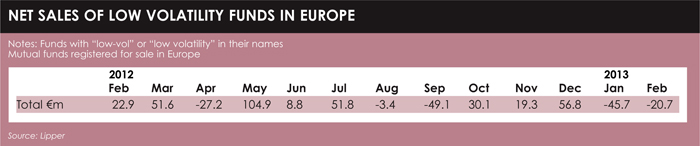
The danger then is that investors fly the coop. Interestingly, although low volatility funds did well when markets were rising in the first quarter of 2013, Lipper figures for the sector show outflows in January and February.
It is hard to draw wide-ranging conclusions from these figures, however, as Lipper does not have a category for low volatility funds. Figures are based on funds with the words “low volatility” in their names and under-represent the sector.
This highlights another problem with low volatility investing. How do you define it? Most low volatility funds and indices aim to reduce volatility by about 30%. Beyond that, as van Vliet puts it, “It’s like value investing. The devil is in the detail.”
In the UK, this problem has been exacerbated by the Retail Distribution Review (RDR). This has led to the launch of funds with specific risk profiles. They are designed to plug the advice gap created by the transition from commission-based to fee-based financial advice, but while some target a specific volatility level, others target a specific return. This, according to Nick Smith, head of retail sales (ex-Germany) at Allianz Global Investors, is a problem.
RISK PROFILE
“One of the downside of these strategies is the lack of clarity we have seen in the market place in positioning these kinds of products,” he says.
“Some of the funds that are filling this space specifically target a volatility level rather than a return. These funds are much more likely to stay in their risk profile over the long term. However, other funds are receiving risk profiles, but are targeting a return rather than a volatility. This means they could change risk profile, forcing advisers to re-advise and potentially alter client portfolios.”
Allianz Global Investors’ own offering in this sector is the Allianz Risk Master fund range. These are risk-rated, multi-asset funds that aim to deliver returns within four defined volatility bands. They invest mainly in ETFs and physical bonds, with some exposure to absolute return strategies.
In other words, they have very little in common with actively managed equity funds such as the Robeco Conservative Equity funds, the Unigestion funds and the Calamos emerging markets fund, or with a convertible bond fund such as the Calamos Global Convertible Opportunities fund. How, then, are we to assess the low volatility investment sector?
It is not really possible to make many generalisations. Low volatility, minimum variance, target volatility: call it what you will, this sector – if it can even be called that – covers a wide range of tools, objectives and philosophies. Furthermore, simply targetting low volatility does not a world-beating portfolio (or index) make.
LIMITATIONS
Jourovski is not alone in pointing out the limitations of assessing stocks only according to their volatility. “Risk is a complex animal,” he says. “There are plenty of cases where volatility goes down but the qualitative risk goes up. For us, volatility is just one risk indicator.”
Another obvious problem is that were everyone to invest in low volatility stocks, their price would go up. Therefore including valuation in the model is important, although it does depend on your goal. If your goal is to lower volatility rather than to achieve good long-term returns by investing in low volatility assets, then you might not mind if the stocks become expensive.
“Would the stocks become more expensive? Yes,” says Beckley. “But would they become more volatile?”
 What does tend to unite all these strategies is a belief in the long term and a certain sobriety of approach. Low volatility investing is the antithesis of chasing hot stocks.
Calamos Investments is “looking carefully” at a long/short strategy.
©2013 funds europe