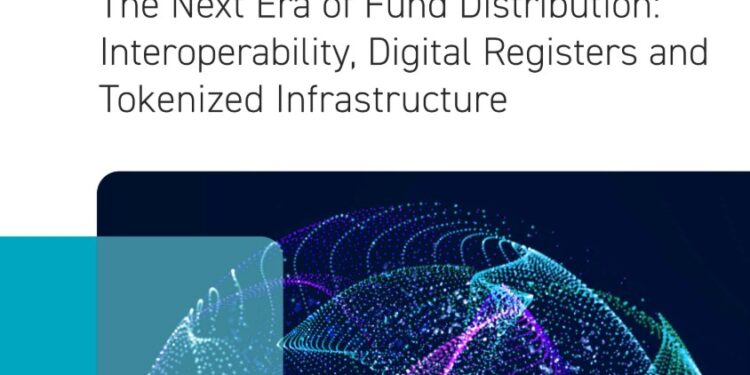
Disruption from tokenisation will apply to the full value chain and is not just an issue about digital fund units, stresses a White Paper published by Clearstream and Deloitte.
Titled The Next Era of Fund Distribution: Interoperability, Digital Registers and Tokenized Infrastructure, it implies a change to where control, record keeping and data sit within the fund processing ecosystem; alongside considerations of interoperability – it is unrealistic to expect an immediate migration to fully on-chain infrastructure – it suggests continued reliance on traditional dealing platforms and digital rails, which points to an ongoing need to manage the industry’s legacy backbone alongside new digital distribution networks. In the area of transfer agency, the shift is towards real time blockchain enabled solutions bringing efficiencies.
Questions posed by the paper in mind of the changing environment include:
- Which parts of the fund value chain are strategic to own, and which can become shared infrastructure?
Where do asset managers need investor-level transparency, and where are omnibus models still fit
for purpose? - Which products are best suited for tokenised distribution first: market money funds (MMFs), ETFs, private markets, or other alternatives?
- How do we avoid creating new digital silos while solving old operational fragmentation?
- Who will orchestrate interoperability between traditional dealing, digital registers, custody, settlement, and new distribution channels?
It goes on to add: “The winners will not be those that simply launch a tokenised share class, but those that can operate across traditional and digital rails with scale, trust, and interoperability.”
Managers need to think strategically about how to simplify and automate operations “and then selectively adopt tokenised infrastructure where it delivers measurable benefits” such as faster processes, lower error rates, improved client experience and greater transparency.
Managers should not confuse application of tokenisation as a product level feature with the deeper opportunity present: converting the operating model to one that is digital-first, driven by data, and which facilitates interoperability.
The Paper outlines a path forward comprising four key steps: reducing internal fragmentation through standardisation of data and workflows; modernising the investor record through digital registers and API-first integration models; pilot tokenised share classes within controlled environments to better understand governance and control implications; and scale selectively as standards, regulation and settlement infrastructure continue to mature.
Looking to the horizon, the paper introduces a provocative post-fund hypothesis. As both underlying assets and cash legs become natively tokenised, the traditional fund wrapper itself may become optional. Portfolios could eventually be assembled directly from tokenised, composable building blocks with programmable rules embedded within digital wallets. For forward-thinking asset managers, strategic positioning will depend entirely on their ability to integrate with these shared infrastructures rather than trying to build standalone, digital silos.
Full insights, including on the post-fund hypothesis, can be found here.