European defence ETFs continue to attract investor interest despite a slowdown in inflows this year, with fund managers arguing that long-term spending commitments and evolving warfare technologies support the sector’s growth prospects.
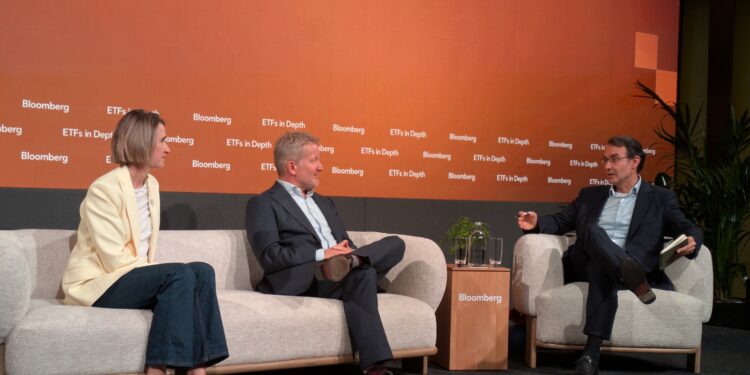
Speaking at Bloomberg’s ETFs In Depth London event last week, Marie-Sophie Pastant, head of ETF and Index Portfolio Management, BNP Paribas Asset Management and Martijn Rozemuller, CEO Europe, VanEck, shared their views on this topic.
Defence-themed ETFs enjoyed strong inflows in 2025, but investor attention has recently shifted towards artificial intelligence, high-profile IPOs and space-related investment opportunities. Defence ETFs accounted for a significant share of thematic ETF flow. At the same time, investors have favoured European exposure over global defence strategies, shared the panellists.
While some of the sector’s traditional leaders have retreated after strong gains in recent years, companies linked to communications systems, data processing, drones and defence technology have continued to outperform. Valuations had become stretched following strong retail investor demand in 2023 and 2024, particularly among European defence companies. As geopolitical tensions eased somewhat and investors rotated into themes such as AI and space exploration, some profit-taking emerged across the sector, they said.
Governments across Europe have committed to increasing defence spending over multi-year periods, creating greater visibility over future revenues and order books for defence companies. Pastant and Rozemuller also highlighted that many defence businesses now have order books extending three to five years ahead, providing an unusual degree of earnings visibility.
The sector is being viewed less as a high-growth trade and more as a long-term strategic allocation supported by predictable revenues and government-backed spending programmes. Panellists said that this transition from a growth story to a value proposition could make defence investments attractive to a broader range of investors.
Modern warfare increasingly relies on data processing, sensors, communications systems, cyber capabilities, drones and space-based intelligence alongside traditional military hardware, they highlighted. As a result, defence ETF construction is evolving beyond exposure to weapons manufacturers. Fund managers said they are increasingly incorporating companies involved in logistics, communications infrastructure, sensors, software and data analytics that support modern defence capabilities.
While European spending is expected to rise, investors were encouraged to maintain a global perspective, noting that important defence capabilities remain concentrated in the US and Asia.