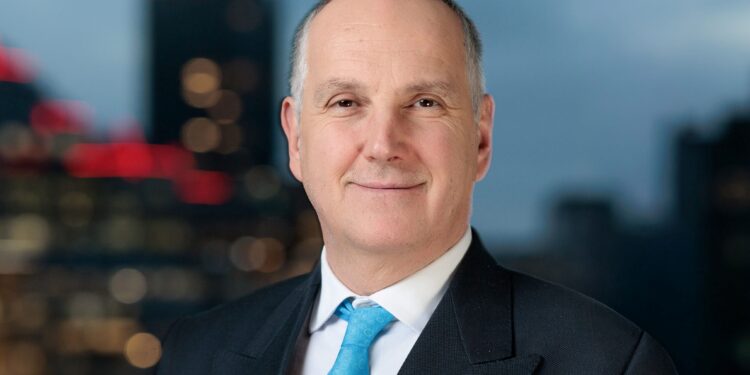
In an industry addicted to performance tables and quarterly noise, Furio Pietribiasi is making the case for patient long-term performance.
“We’re not looking at quarterly results,” he says. “We’re looking at the long-term and we’re looking what is best for our clients as well.”
Mediolanum International Funds is a division of Milan-based Banca Mediolanum group, in which the family of the populist Italian prime minister Silvio Berlusconi family hold a 30% stake.
The division is authorised in Ireland to manage Ucits and non-Ucits funds, oversees more than 70 funds and had €76.9bn in assets under management at the end of December 2025.
It serves, through the Mediolanum group’s distribution network, more than 2 million clients, with a sales force of more than 6,700 “family bankers” in Italy and Spain, as well as independent financial advisers in Germany and institutional investors.
Pietribiasi has been in Dublin since 1998 from where he is responsible for Mediolanum’s business operations in Ireland, is chief executive of its European asset-management platform and a board member of Mediolanum International Life, the group’s insurance arm.
He has also served on the boards of the Irish Association of Investment Managers and Financial Services Ireland, contributed to government-backed advisory groups and co-chaired the Brexit stream of the Anglo-Irish High-Level Dialogue.
Educating rather than selling
Over more than an hour of conversation, Pietribiasi returns several times to the same proposition: Mediolanum does not really sell products. Literally, of course, it does but it should not think of itself as doing so.
“I always say that we don’t sell products to our clients,” he says. “Our financial advisers, they are financial planners.” Their role, in his account, is not to predict markets but to coach savers: why they need to invest, how volatility works, why compounding matters and why panic is destructive.
“People are scared about volatility,” he says. “People don’t understand that volatility can be a fantastic ally to generating long-term wealth if you know how to approach it.”
This approach helps explain the architecture of the business he has spent nearly three decades building in Dublin. Mediolanum’s core identity is multi-manager, he says, blending internal teams with external boutiques and large houses, rather than betting the franchise on a single in-house star.
One-third of total assets, Pietribiasi says, are managed internally across fundamental fixed income, fundamental equities and quantitative equities. The rest are blended with external capabilities, such as mandates with BlackRock, JP Morgan and Schroders.
Around 55 to 60 per cent of assets are in equities, he says, down from a peak of roughly 70 per cent, with the rest in fixed income.
Institutional investors may tolerate long stretches of underperformance from a talented manager if they believe the process is intact but retail clients, Pietribiasi argues, do not.
“Explaining is not enough,” he says. “Clients are not technical people and then they tend to forget. Their emotion triggers when they look at the numbers.”
So Mediolanum tries to flatten the experience. “By doing this we eliminate the peak and the trough in the volatility of the performance,” he says of the multi-manager model. “We will never be the first but we’ll never be the worst.” The ambition is not to top every table, but to stay above the median often enough that clients remain invested.
There is a quiet heresy in that. Much of active management still markets itself through the outperformance stories of charismatic celebrity stockpickers. Pietribiasi is effectively arguing that, for the affluent retail investor, being less exciting may be a better option.
The numbers suggest the approach has found an audience. Assets under management now stand at around €77bn, up from roughly half that level seven or eight years ago, he says. Growth has been consistent rather than explosive. He is careful not to present it as asset gathering for its own sake. “We are not racing for assets,” he says. “What we are trying to do are products that are valuable for our investors.”
That also informs his resistance to fads. He cites ESG as an example of the industry’s tendency to sprint after labels and then retreat when the cycle turns. “We don’t run after fashionable trends,” he says.
Mediolanum joined the sustainability push later than some rivals and did so, he says, because it saw long-term economic rationale in themes such as clean energy and sustainable nutrition, not because disclosure categories had become a marketing imperative.
2025 brought lower revenues than the previous year, largely because volatility in the first quarter hit asset values and because 2024 had been unusually strong for markets, flows and performance.
Even so, he argues that the underlying mix remains healthy, with management fee revenues stronger year-on-year.
Born in Milan into a family of entrepreneurs and raised from childhood in the Veneto in Italy’s north-east, Pietribiasi studied economics, finance and commerce at Trieste University before starting work in 1996 with Mediolanum Gestione in Milan as a financial analyst and equity portfolio manager.
The creation of the euro and the arrival of cross-border fund structures in the 1990s exposed, he says, the limits of the old domestic Italian model. Luxembourg and Ireland offered more flexible, scalable fund regimes, with umbrella structures, outsourcing and passporting advantages that Italy lacked.
Mediolanum chose Ireland rather than Luxembourg as its asset management base because of (at the time) a greater sense of tax transparency in Ireland, and a desire to avoid any association, however unfair, with the mystique of banking secrecy, which the Grand Duchy still espoused in the 90s.
In addition, Ireland positively encouraged multi-asset products at a time when Italy did not permit outsourcing or umbrella fund structures, nor multiple share classes at sub-fund level, which had tax consequences for investors switching between funds.
Ireland, he says, was also out in the market selling itself. Ministers were travelling, making the case that the country was open for business.
That bet turned out to be prescient. Ireland has since become one of Europe’s key homes for funds and ETFs, while Mediolanum’s Irish arm has become more than a back-office domicile.
The 55-year-old father of two is plainly proud of the fact that the business was built locally rather than transplanted wholesale from Italy. “We don’t want to have an Italian business in Ireland,” he says. “We want to have an international business in Ireland.”
Today, he says, the company employs about 250 people directly and has 19 nationalities across the business.
Active versus passive
Pietribiasi is not against passive investing in any doctrinaire sense. He concedes that ETFs can be useful tactically and are available to clients through the wider banking and distribution network. But he remains suspicious of the idea that the industry’s future is merely a race to lower fees and greater commoditisation.
In fixed income, he argues, active management still gives investors a fair chance of beating the market; in equities, the challenge is harder, if one is willing to invest enough in research, technology and manager selection. Many firms, he suggests, have chosen instead to declare the game unwinnable and retreat into passive products because it is cheaper to do so.
Here again he departs from the industry consensus. His argument is not that active management always wins; it is that good active management is expensive to build and that too many firms have decided not to try because of that.
Pietribiasi is warm about the country and effusive about Irish people, whom he describes as open, entrepreneurial and resilient. But he also thinks wealth can make any place a little complacent.
Brexit, in his account, was not simply a regulatory nuisance or a commercial inconvenience. It was a strategic loss for Europe: a reminder that financial ecosystems do not stand still, and that competitive positions can erode if they are taken for granted.
London’s financial and intellectual capital was pushed outside the bloc even if commercial ties remained. Ireland, he thinks, now has to redefine itself more assertively inside Europe, on its own terms.
He speaks enthusiastically about artificial intelligence, but not as a substitute for young analysts. Quite the reverse, in fact the availability of a well-educated workforce was one of the reasons Mediolanum moved to Ireland in the first place.
The notion that firms should stop hiring young people because software can do entry-level work strikes him as “madness”. Used properly, he says, technology accelerates development; it does not abolish the need for people. “In the long-term,” he says, “businesses will still be run by people.”