Adequate data is becoming more crucial at every stage of the capital-raising process in real estate, with poor data strategy and governance making capital raising more challenging, noted Christopher Woodley of Savills Investment Management in discussing the ‘Data at the crossroads’ report.
“At all stages of the capital raising process now, data is becoming more crucial and more requested, be it marketing, consultant requests, RFPs or due diligence,” he said.
“The data requirements around all of that are much greater than they used to be [and] I really think there is an expectation now from LPs that all of those requirements are met and that you can really evidence good governance in this area.”
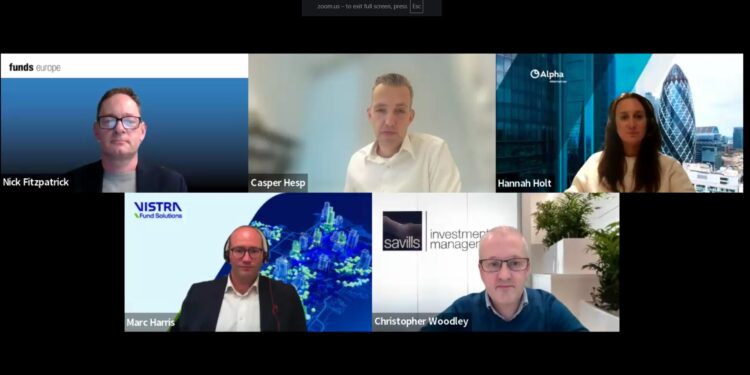
Woodley was speaking at a Funds Europe webinar about real estate data in investment decisions. The webinar runs adjacent to a Funds Europe ‘Data at a crossroads’ report, which surveyed real estate investment professionals and is published in association with Vistra Fund Solutions.
It’s “quite a tough” capital-raising environment and data is an area that “we can’t fall behind on”, he said.
Hannah Holt of Alpha FMC said LPs are asking increasingly sophisticated questions around ESG, performance, and risk exposure.
“I think often it’s not that firms don’t have that data, it’s just that it’s not consistent, comparable, or trusted and validated,” she said, adding that this forced firms to look at data as a business-critical issue.
“The firms that are doing this well are not letting the complexity of the European market stand in the way of being data-forward”
EU’s data complexity problem
The ‘Data at a crossroads’ report found that EU-based firms rated their data quality lower than peers in North America and APAC. Was this just an anomaly in the data? Marc Harris of Vistra Fund Solutions the percentage difference was significant enough to be more than just a quirk.
“We feel that it’s down to the regulatory complexity and compliance burdens, and then also the market fragmentation across Europe.”
“Obviously, on the complexity front, EU firms have got to navigate AIFMD, MiFID II, and they’re subject to different interpretations across 27 member states. So, there’s a lot of political and operational fragmentation that’s not mirrored in more homogenous places like the US and APAC markets. Layers on top of strong EU mandates around ESG, and sustainability platforms, which you just simply don’t get in the US.”
Alpha FMC’s Hannah Holt said EU firms worked disparate operating partners, each with their own systems, their own processes, and sometimes different languages – a situation in contrast to North America where there is also wide adoption of tools like Yardi and Argus.
“You get that common technology baseline that makes it much easier to aggregate the data. Whereas in Europe, that market consolidation just hasn’t happened to the same degree. [Firms are] often stitching together data that is coming from different operating partners in different formats, who’ve been specifically chosen for their local expertise, rather than their tech stack.”
“The key lesson, she said, is that firms operating across Europe need to invest more in their data governance layer, standardisation, and validation processes that sit above the disparate data sources because firms cannot rely on consistency at source level.”
“You do have to build it centrally, and I think the firms that are doing this well are not letting the complexity of the European market stand in the way of being data-forward.”
The webinar discussion featured:
- Casper Hesp, CEO, InRev
- Hannah Holt, director for real assets, Alpha FMC
- Marc Harris, head of real assets, Vistra Fund Solutions
- Christopher Woodley, head of performance and data management, Savills Investment Management